Most leaders still believe that rolling out AI assistants is all that’s needed to increase productivity and outcomes. That could not be further from the truth. If you’re leading AI adoption, focus on three things: growing a people-first community, balancing fast experiments with standard operating ways to ship value, and creating easy, shared access to governed AI environments.
That’s why I invited Ivo Strohhammer, AI Lead at Siemens and the incoming CEO of the AI Cluster Zug (Switzerland), to join me on “What’s the BUZZ?”. Here is what we talked about…
Build a Learning AI Community that Actually Works
When I talk with leaders, the first thing I hear is pressure for quick results. But the real lever is your people. Start by creating a low-friction community that mixes curious users, practical trainers, and legal/IT advisors. Give everyone a clear path to contribute: basic access for casual users, quick entry-level training for those who want to participate, practical workshops for people who will run pilots, and a small group of go-to contacts who take ideas over the finish line.
Practically, set up a tiered champion program:
Level One is membership and access to a shared playground
Level Two covers short online courses and a simple test to confirm understanding
Level Three is hands-on delivery such as running an ideation session or building a simple prototype
Level Four is a named local contact who connects teams to deployment support
Keep the learning material curated and short. Avoid throwing a dozen training links at people. Make play environments safe and sandboxed so staff don’t go outside corporate agreements just to try things. The goal is to move people from passive curiosity to repeatable practice, so your next wave of pilots actually comes from informed users instead of guesses.
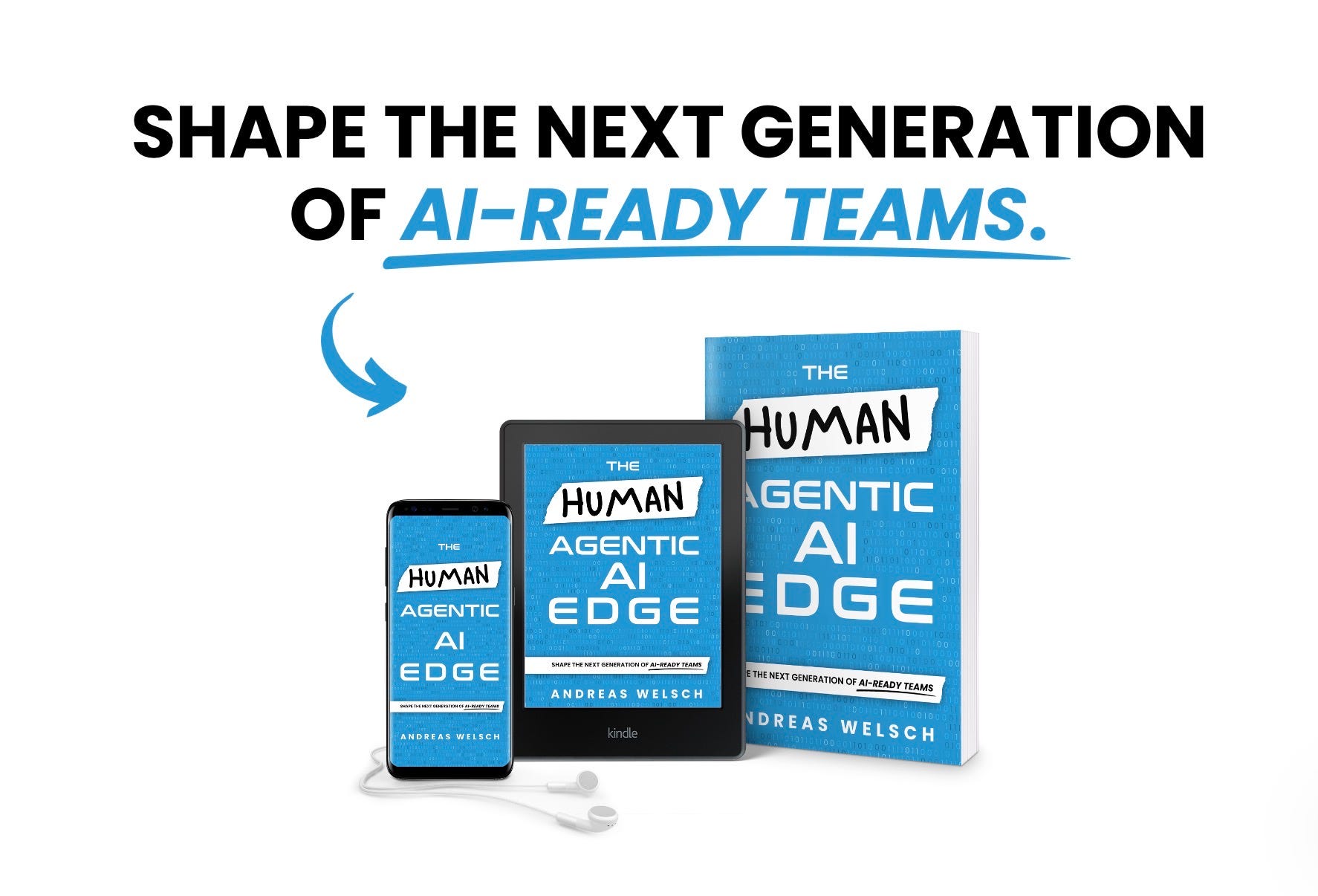
NEW BESTSELLER: The HUMAN Agentic AI Edge
Organizations are racing to deploy Agentic AI, yet few are ready for the risks that emerge when employees use AI without structure, standards, or oversight.
The HUMAN Agentic AI Edge offers leaders a practical blueprint for building accountable AI-ready teams that consistently produce high-quality results. Drawing on real-world knowledge and insights from interviews with more than 50 AI leaders and experts, Andreas Welsch shows how to combine human judgment with Agentic AI capabilities to reach the level of performance many organizations expect but rarely achieve. This book prepares you to shape the next generation of AI-ready teams delivering high-quality results with high accountability.
You need both speed and order. Experiments teach fast, but too many parallel trials without structure create a mess and waste budget. Use short cycles and plan one-year rhythms for the program with quarterly checkpoints for prioritization. Let local teams run experiments, but require a simple template that covers goal, expected benefit, data needs, security checklist, and a deployment path if the pilot succeeds.
Measure outcomes you can act on. For process changes, don’t expect huge gains just by “adding AI.” Often, you need to rethink the process end-to-end to capture real value, not just a marginal improvement. For personal productivity wins, recognize that they’re hard to measure directly but powerful for morale and adoption. Consider proxies: reduced time to complete standard tasks, fewer revision cycles, or faster response times.
When experiments show promise, move them into a repeatable delivery lane of building standard components, shared APIs, and a deployment checklist so teams don’t reinvent the same work. Keep governance light but consistent: security signoff, data handling rules, and a standard way to log reuse. That balance of fast learning plus simple standards lets pilots graduate into programs that scale.
Thanks for reading The AI MEMO! Share this thought-provoking post with your network.
AI programs are not just limited to large multinational organizations. Even smaller firms that don’t have large IT or AI teams can innovate with AI as well. They need quick access to tools, straightforward learning, and a place to get help. Use a triple-A framework:
Awareness: short explanations of what AI realistically does and doesn’t do
Ability: hands-on sandboxes and short role-based courses, and
Application: ready-to-adopt templates or minimally viable workflows.
Offer shared assets such as legal templates, a secure model playground, curated training playlists, and industry-specific starter kits.
Make secure options prominent: when people don’t see a sanctioned tool, they’ll use public ones and expose data. That risk is avoidable by offering safe, easy-to-use alternatives. Community events and peer-sharing help small firms learn faster when they can borrow patterns rather than building everything from scratch.
Summary
Three moves you can make this week: (1) start a tiered champion program so employees can learn and contribute in practical steps; (2) set short cycles and simple templates to keep experiments useful and move winners into repeatable delivery; (3) create shared assets to adopt AI safely without huge budgets. These actions reduce wasted effort, increase real adoption, and give you concrete wins to show stakeholders.
What you can do right now
- Run one 60-minute sandbox session for any team that wants to try an AI task with safe tools.
- Require a one-page plan for every pilot (goal, data, compliance check, scale path).
- Publish three starter kits for common functions (customer messages, meeting notes, document summarization) that include a secure tool option.
Equip your team with the knowledge and skills to leverage AI effectively. Book a consultation or workshop to accelerate your company’s AI adoption.
Join my bi-weekly live stream and podcast for leaders and hands-on practitioners. Each episode features a different guest who shares their AI journey and actionable insights. Learn from your peers how you can lead artificial intelligence, generative AI, agentic AI, and automation in business with confidence.
March 31 - Elise Neel (SVP of Global Strategy & Strategic Partnerships at Panasonic) will share how to scale executives’ time with specialized agents. [More details to follow on my LinkedIn profile…]
Watch the latest episodes or listen to the podcast