The second half of the year has not eased the pressure on leaders to push AI down into their organizations. Agentic AI sits on most roadmaps; budgets are already committed, and in many companies, the mandate came from the top with a headcount attached. What follows is almost always structured as a technology program: a platform decision, a license count, a pilot, and a maturity assessment that asks only about the technology's maturity. That scoping is where the money starts going wrong. To explore how AI transformation can be neuro-inclusive, I invited Christina Fischer (Managing Consultant at Human Pattern Works) to join me on “What’s the BUZZ?” Here’s what we talked about…
Score All Four Dimensions Before Funding Any One of Them
A maturity audit worth running looks at your organization, or at a single business unit inside it, across process, work culture, compliance, and technology, and rates each of the four on a scale from bronze to silver to gold across five working pillars. The picture that comes back is almost always uneven. You can score well on two dimensions, sit mid-range on a third, and carry a genuine blind spot in the fourth without anyone ever having named it out loud, because nobody has been asked to score anything except the stack.
What sits in that blind spot is unmined potential, and the term is more ordinary than it sounds. It means talent you already employ but do not support, product ideas that live in people’s heads and have never been written down, and data that gets collected but never used. None of that surfaces in a technology assessment, and none of it is resolved by another round of licenses.
The business consequence is direct. Keep funding the dimension that is already strongest, and your ROI case quietly assumes the remaining three will follow, which overstates the return before the first pilot ships. The sequence worth adopting is the reverse one. Score all four dimensions honestly before you approve the next tool, decide which of them is actually your constraint, and put the money against the constraint. Gold is not automatically the right target either, because moving your weakest dimension one step up will usually yield more than another round of seats on the strongest dimension.
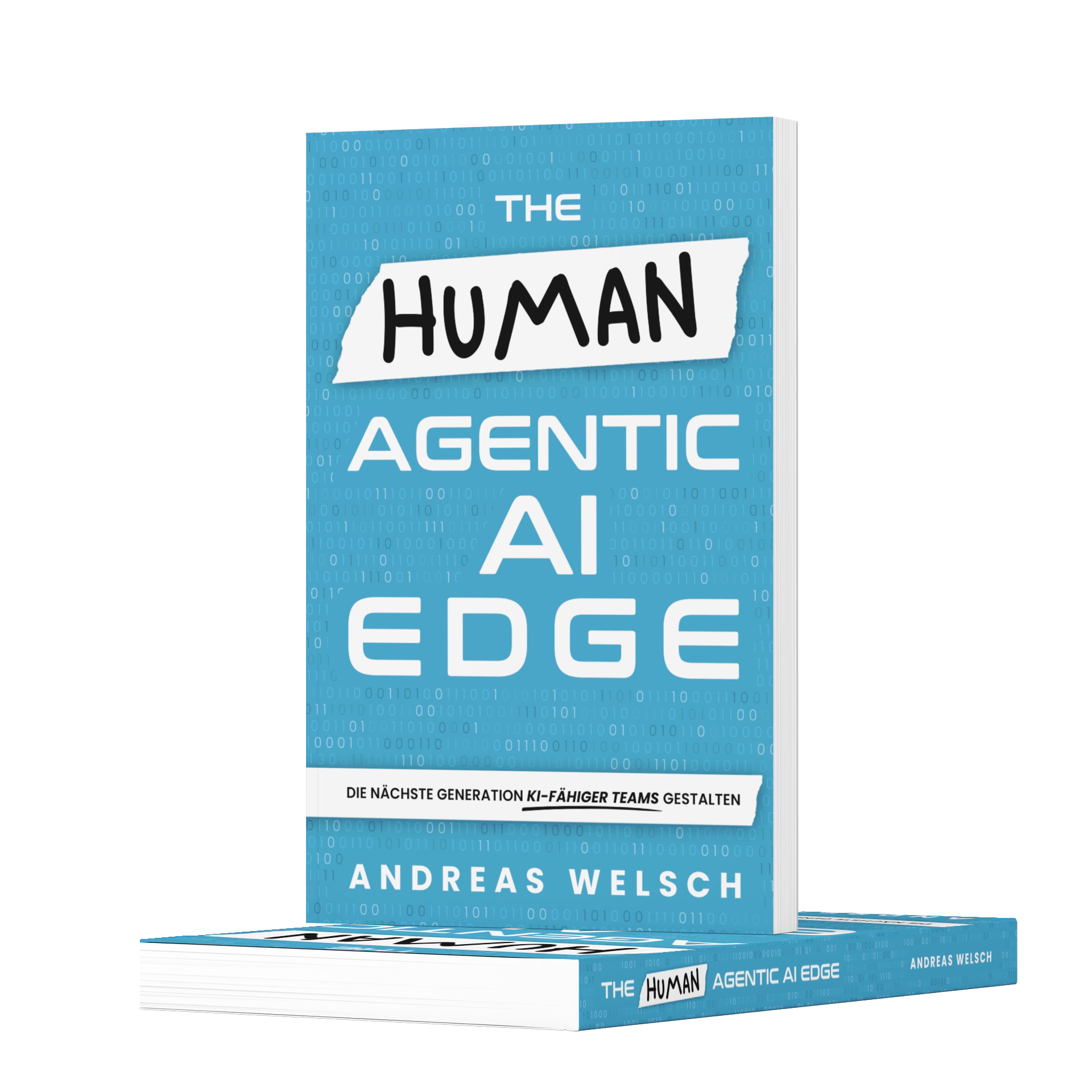
Get your copy: The HUMAN Agentic AI Edge
Organizations are racing to deploy Agentic AI, yet few are ready for the risks that emerge when employees use AI without structure, standards, or oversight.
The HUMAN Agentic AI Edge offers leaders a practical blueprint for building accountable AI-ready teams that consistently produce high-quality results. Drawing on real-world knowledge and insights from interviews with more than 50 AI leaders and experts, Andreas Welsch shows how to combine human judgment with Agentic AI capabilities to achieve the performance many organizations expect but rarely deliver. This book prepares you to shape the next generation of AI-ready teams delivering high-quality results with high accountability.
The Earliest Signal Sits Outside the Middle of the Distribution
Friction in a rollout shows up in individual people long before it shows up in aggregate numbers. That's why your quarterly engagement survey is a poor early warning system: the middle of any distribution quietly absorbs friction for a long time, which is why the aggregate keeps looking acceptable until it suddenly doesn't.
The people whose working needs sit outside that middle are the exception. Someone who needs unusual clarity on objectives, or a quieter place to concentrate, or flexibility in how the working day is structured, will encounter a badly designed way of working before anyone else does. In the worst case, that person breaks first. In the best case, that person speaks up first. Either way, you are being handed real information about your own rollout, of a kind no survey will produce on that timescale, and treating it as a complaint to be managed throws away the cheapest signal available.
That signal is only worth something if you have built somewhere for it to land. Design feedback loops that reach past OKRs and next year’s numbers into standing conversations where people can say where they think the department is heading, what is getting in the way, and which ideas nobody has asked them for yet. That is a work-culture change first and an AI change second, and it costs very little set against the alternative. Finding out in week three that a new way of working does not fit how the work actually gets done costs you a conversation. Finding out in month nine costs the program, the change fatigue that accumulated along the way, and some of the people you most wanted to keep.
The Pressure Point is Already Visible
Inside individual teams, collaboration and honest conversation tend to work reasonably well. The break happens higher up, where expectations coming down from executives and expectations coming up from the team converge on the same person. That person is typically a middle or senior manager who must deliver value as an individual contributor while leading people, and in larger companies, several such layers are stacked on top of each other.
The support available to those managers is uneven and largely accidental. Whether one of them gets coached, backed, and given room depends on who their own manager happens to be rather than on any system the company deliberately operates. That was tolerable when most questions had a clean yes-or-no answer. It is not tolerable now, when the answer is more often yes under these conditions, no under those, and the conditions themselves are moving. Support at that layer is a requirement of your operating model, not a perk attached to good luck.
Measurement is where the same problem does quiet damage. Logged keystrokes and hours at a desk are easy to collect and say little about work quality, and both substitute monitoring for the trust that makes distributed and flexible work function at all. The pandemic demonstrated that the flexible version works when a company invests in the tooling to support it, and the restrictive swing since then has been driven at least as much by committed real estate as by any evidence about output. The commercial catch is who walks. The profile you will need more of, meaning domain experts, architecture experts, and the people who can sketch the big picture and then write the governance rules, is precisely the profile that selects an employer on this basis.
Summary
AI transformation is not a technology project, and the maturity gaps that determine whether it pays back usually lie in processes, work culture, and compliance rather than in the stack. The people whose working needs sit outside the middle of the distribution feel a badly designed rollout first, which makes them the earliest and cheapest signal available to you, provided somebody has built a place for that signal to land. And the managers in the middle, who absorb both sets of expectations while still delivering as individual contributors, need a deliberate support system and metrics built on trust rather than surveillance. If the first person in your organization to say the AI rollout isn't working spoke up tomorrow, would you hear it as a complaint or as data?
Equip your team with the knowledge and skills to leverage Agentic AI effectively. Book a consultation or workshop to accelerate your company’s AI adoption.
Join my bi-weekly live stream and podcast for leaders and hands-on practitioners. Each episode features a different guest who shares their AI journey and actionable insights. Learn from your peers how you can lead artificial intelligence, generative AI, agentic AI, and automation in business with confidence.
October 27 - Walter Schmidli (VP of Paid Social at CMI Media Group) will talk about how leading brands remain discoverable as Agentic Commerce rises in popularity. [More details to follow on my LinkedIn profile…]
November 10 - Stefano Osteria (Global Vertical Leader Logistics and Warehouse Management at Belden) will share how leaders must keep warehouse management and logistics in lockstep with Agentic Commerce innovation in the front-office. [More details to follow on my LinkedIn profile…]
November 17 - Jess Graham (CEO and Founder of Banquet) will be on the show to discuss which channels your brand need to own to retain the buying context in Agentic Commerce. [More details to follow on my LinkedIn profile…]
December 01 - Wayne Butterfield (Fractional Chief AI Officer) will share how companies can leverage Agentic AI for customer support to close the loop of Agentic Commerce. [More details to follow on my LinkedIn profile…]
December 15 - Jon Reed (Industry Analyst & Co-Founder of diginomica) and I will close out the year with a review of the biggest topics in the mirror, and the most impactful ones ahead.
Watch the latest episodes or listen to the podcast
Spot-on assessment. All of our "control" systems and most of our performance management and engagement tools are some combination of activity monitoring (office attendance, tool usage, output generated) and rear-view mirror (annual engagement scores that no one does anything with). Real change requires a lot more fundamental rethinking of how you align and compose teams with a variety of skills (and gaps), what support they need and how you make sure your real culture (rewards systems, behaviors you encourage as well as what you tolerate) will make your objectives possible or pointless.
Worth adding: the headcount-attached mandate you mention often becomes its own trap. Leaders hire an AI team to prove the budget was justified, and that team's incentive quietly shifts from 'change how work gets done' to 'ship something visible before the next review.' Curious whether you're seeing that pressure show up in how pilots get scoped.



Spot-on assessment. All of our "control" systems and most of our performance management and engagement tools are some combination of activity monitoring (office attendance, tool usage, output generated) and rear-view mirror (annual engagement scores that no one does anything with). Real change requires a lot more fundamental rethinking of how you align and compose teams with a variety of skills (and gaps), what support they need and how you make sure your real culture (rewards systems, behaviors you encourage as well as what you tolerate) will make your objectives possible or pointless.
Worth adding: the headcount-attached mandate you mention often becomes its own trap. Leaders hire an AI team to prove the budget was justified, and that team's incentive quietly shifts from 'change how work gets done' to 'ship something visible before the next review.' Curious whether you're seeing that pressure show up in how pilots get scoped.