No matter if you follow the AI hype, live it, or create it, 2025 has been a whirlwind of news and announcements for enterprise leaders. AI vendors are ahead of their customers’ ability to absorb and adopt all the available innovations fast enough to keep pace. Although many like to promote it as such, AI agents aren’t a magic fix as this new year will show more visibly.
Resorting to tried and tested principles, and adapting them for Agentic AI, will be a good starting point for many organizations: start with data, clear internal goals, and small, supervised agent workflows that deliver measurable results.
I recently invited Jon Reed, Co-Founder and Industry Analyst at diginomica, to join me on “What’s the BUZZ?” and discuss how enterprise AI has evolved and accelerated in recent months, and what’s ahead.
Communicate Your AI Strategy Clearly
If you lead an IT or line-of-business team, you need to decide what AI will do in your area, and be explicit about the workforce impact. Say whether AI is meant to reduce repetitive work and free people for higher-value tasks. Teams that communicate a clear position get faster buy-in and fewer surprises.
Set a short, honest message for employees; explain training and re-skilling resources; name the areas where AI will be used first; assign leaders who own each AI rollout. Don’t announce vague commitments like “AI first” and walk away. Treat AI like a capability that augments staff rather than a secret scoring metric. Also, expect different messages across divisions as some groups may want aggressive cost reduction while others want productivity boosts. Make that trade-off explicit so managers and employees can plan.
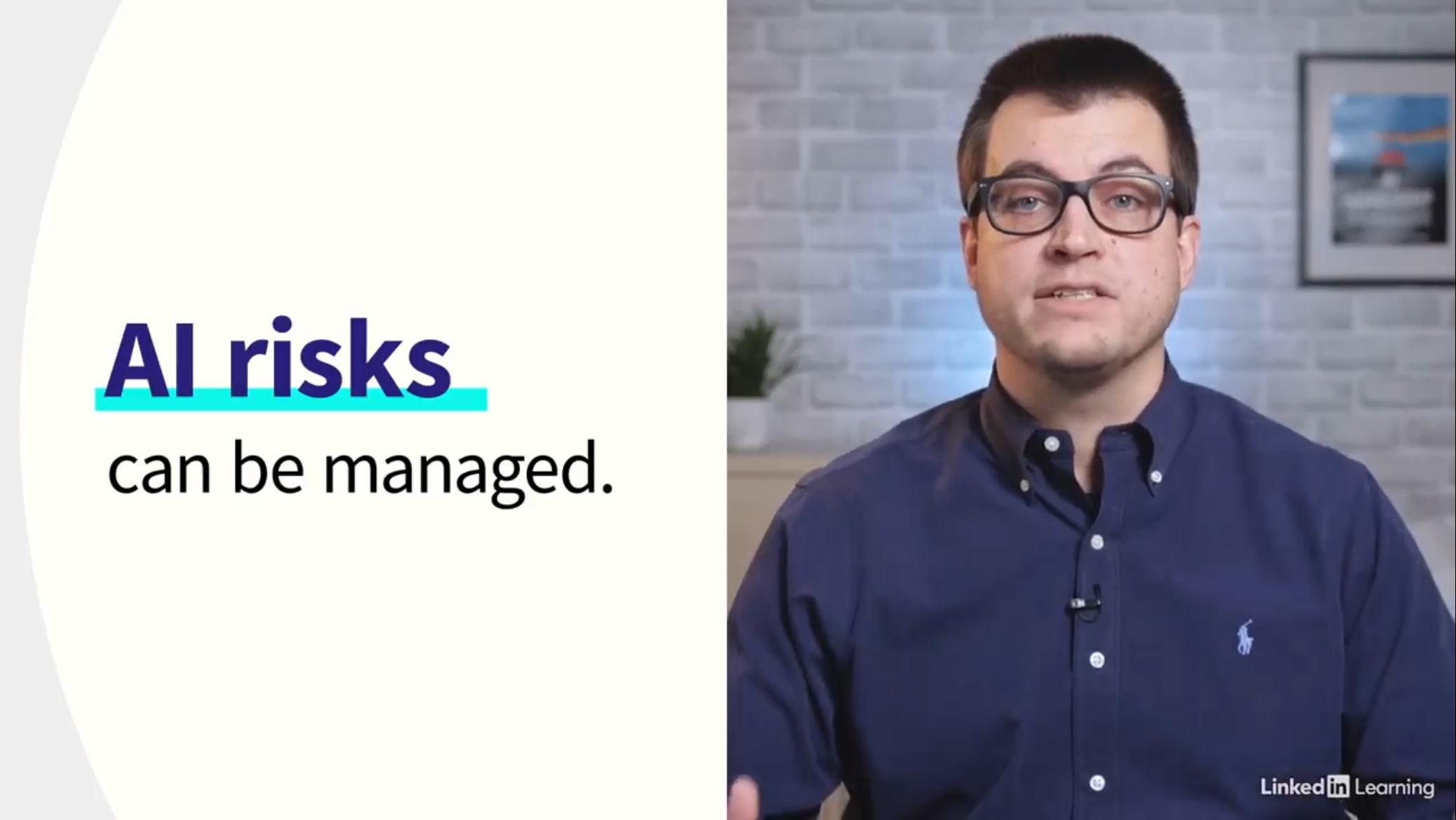
ONLINE COURSE — Mitigate AI Business Risk
Business leaders are under pressure from their boards and competitors to innovate and boost outcomes using AI. But this can quickly lead to starting AI projects without clearly defined, measurable objectives or exit criteria.
Learn how to implement proven risk mitigation strategies for starting, measuring, and managing AI projects. Along the way, get tips and techniques to optimize resourcing for projects that are more likely to succeed.
There’s a lot of excitement about putting multiple agents together and letting them negotiate. In practice, those multi-agent setups rarely work at scale right now. What does work are compound systems: a combination of smaller models, deterministic automation (RPA), document understanding, and a few task-specific agents that share a single data context.
If you’re asking whether to “agent-ify” everything, pause. Start with a single workflow where context is already consolidated, such as contract intake, supplier RFP triage, or invoice matching. Build a lightweight orchestration layer that calls a document-extraction service, a rules engine (deterministic), and a small model tuned to your documents. Keep humans in the loop for exceptions. This mix reduces hallucination risk and makes errors traceable. It also makes it realistic to test an autonomy toggle, allowing the system to act autonomously for low-risk tasks and requiring human approval for others.
Map the data and tools used in the workflow, pick one or two high-frequency processes, create controlled tests (A/B or parallel runs), measure accuracy and time saved, then iterate. Avoid grand standards projects until you have multiple, working workflows to generalize from.
Thanks for reading The AI MEMO! Share this thought-provoking post with your network.
Enterprise AI needs three practical foundations. First, get your data and processes in better shape. That could mean consolidating customer or supplier records, documenting versions of contracts, or ensuring inventory status is current. Second, practice context engineering. Package the exact documents, annotations, and metadata an agent needs so it does not guess or pull unrelated data. Third, add evaluation and traceability tools so you can audit what an agent used and why.
Companies that raised order automation from the 50–60% range to the 80%+ range did process cleanup first. Legal teams that trained an agent to flag five key NDA clauses then ran it in parallel for weeks before handing off low-risk items now save lawyers’ time for more complex drafting. In all cases, systems that store source documents and show which passages were used for a response make compliance and debugging practical.
Start small and pick a high-volume document type or recurring task, add metadata (who authored, which version), feed only that content to your RAG or retrieval layer, and track outcomes. If something goes wrong, you want to see the entire chain: input → retrieved documents → model output → human decision.
Summary
To move from talk to repeatable AI value in your business, be explicit about what AI will mean for your people and processes, and communicate trade-offs and training plans. Avoid open-ended multi-agent experiments and build compound systems with focused agents, deterministic automation, and shared context instead. Treat AI readiness as a practical stack including clean data, context engineering, and observability, so you can audit and improve.
What you can do now:
Pick one high-volume workflow (contracts, RFPs, invoices, support triage). Run a controlled pilot that combines document extraction, rules, and a focused agent.
Add a basic audit trail: log the documents and snippets used for each agent decision and measure accuracy versus human review.
Equip your team with the knowledge and skills to leverage Agenti AI effectively. Book a consultation or workshop to accelerate your company’s AI adoption.
Join my podcast for leaders and hands-on practitioners. Each episode features a different guest who shares their AI journey and actionable insights. Learn from your peers how you can lead artificial intelligence, generative AI, agentic AI, and automation in business with confidence.