Advertising has always worked on a person. The family holiday you will remember, the car that signals you are doing well, the medicine that makes an embarrassing symptom disappear: each is designed to elicit an emotional response that leads to a purchase. That mechanism does not survive contact with an AI agent, because an agent shopping on a customer’s behalf has no emotions to move.
Most of the conversation about AI in marketing has settled on the easy-to-see part: creativity. Generated images, generated video, generated copy. That is the smaller half of the problem and, more to the point, the smaller half of the budget. What determines whether a product reaches a customer at all is the machinery underneath: how work gets planned, bought, placed, and optimized, and which sources an answer engine trusts when describing a category.
Three shifts deserve a leader’s attention this quarter: where AI money in marketing actually goes, why the agency pricing model is coming apart, and what to do now about visibility in AI-generated answers.
To explore what marketing teams can do today to prepare for the future of agentic advertising, I invited Maarten Albarda (Leading Marketing Expert for Marketing Operations) to join me on “What’s the BUZZ?” Here’s what we talked about…
Finding the Sources That Shape AI Answers
Most marketing teams are currently struggling to measure the impact of Generative Engine Optimization and Answer Engine Optimization. Start from an honest position about the evidence. Every platform in this market is a walled garden that reports on itself, so the search vendor reports on search and the assistant vendors report on their assistants, and there is very little independently verifiable data on what generated answers are doing to conventional traffic.
The likely reality is that the impact is greater than currently reported. Almost everyone who searches now receives a generated answer first, and people conditioned by two decades of useful search results read it, accept it, and stop. The link they follow next may lead straight into a retailer’s app rather than to anything the brand owns.
Ask the same question of several assistants, because they will not return the same answer and, more importantly, will not have drawn on the same sources to build it. Tools now on the market show how a brand is currently represented in each engine and which sources that engine relies on. Comparison shop before buying one, because coverage differs meaningfully between providers. Then read the output as a media list rather than as a report. Those top ten, twenty, or fifty sources are the properties that actually shape the answer a customer receives, and the work becomes about earning a place among them.
That is an authority and relations problem that most marketing teams already know how to solve. The learning threshold is low now. However, what is learned today may not matter in three years, and unlearning and relearning from a standing start in five years is considerably harder than starting imperfectly early.
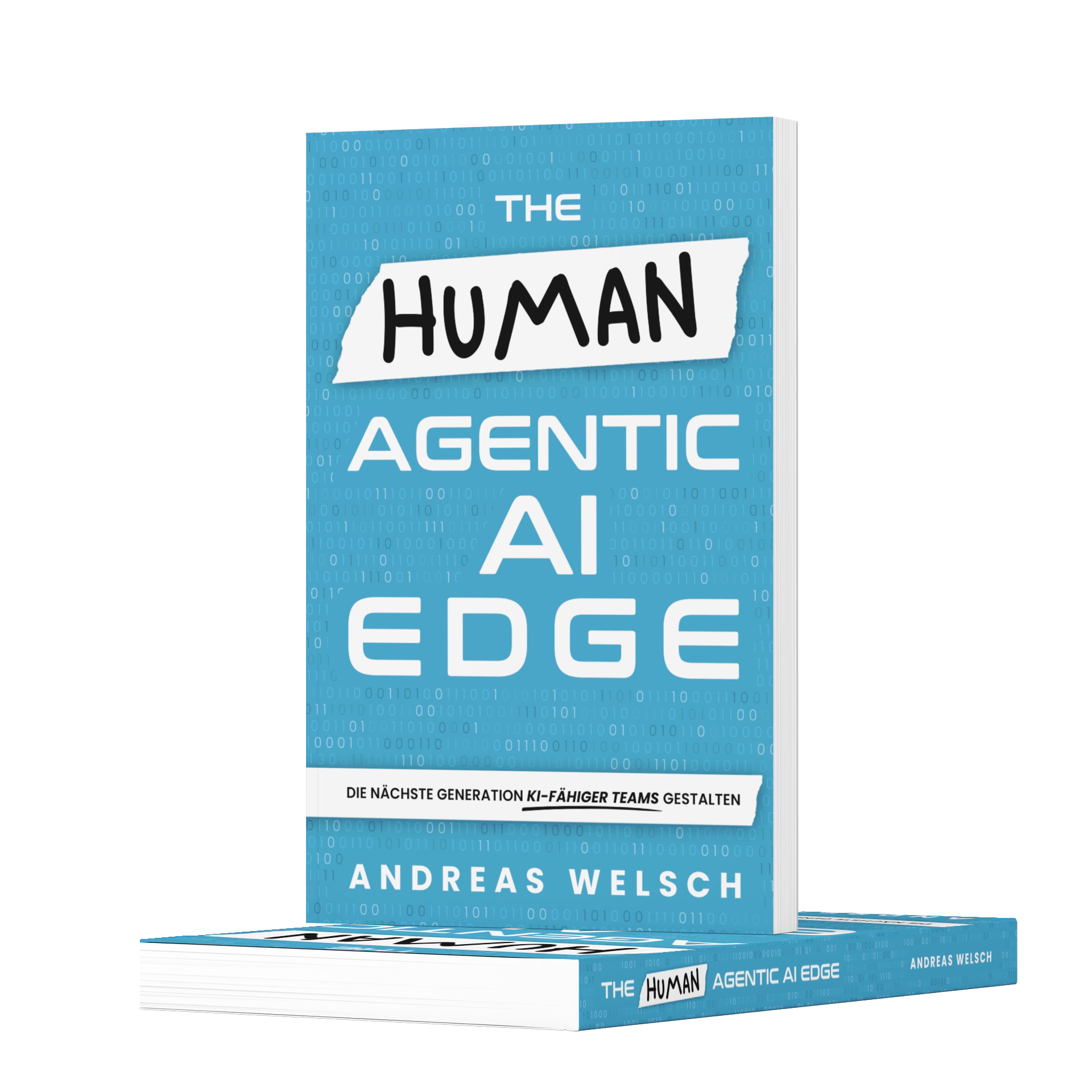
Get your copy: The HUMAN Agentic AI Edge
Organizations are racing to deploy Agentic AI, yet few are ready for the risks that emerge when employees use AI without structure, standards, or oversight.
The HUMAN Agentic AI Edge offers leaders a practical blueprint for building accountable AI-ready teams that consistently produce high-quality results. Drawing on real-world knowledge and insights from interviews with more than 50 AI leaders and experts, Andreas Welsch shows how to combine human judgment with Agentic AI capabilities to achieve the performance many organizations expect but rarely deliver. This book prepares you to shape the next generation of AI-ready teams delivering high-quality results with high accountability.
Separating the What and the How of AI in Marketing
AI in marketing divides cleanly into two halves. The what is the expression of the brand: creating content, writing copy, producing creative, finding new target audiences, testing ads against synthetic audiences. The how is the infrastructure that gets that work made and delivered: work processes, media buying, optimization, placement, and reporting.
Almost all of the public attention goes to the what, because the what is the part customers can see, and a generated ad tends to announce itself. The how has more effect on customers precisely because they never see it, since it determines what reaches them in the first place. And most of the money sits there. Media and creative are real costs, but so are the infrastructure, the people, the tools, and the technology that get the work out the door, and that side is neither visible nor especially interesting to discuss.
Dynamic pricing shows how consequential the invisible half has become. Several airlines and retailers have said they intend to price dynamically using AI for the underlying analysis. Pricing is a marketing decision with a direct impact on revenue, and it never passes through a creative brief or appears in anyone’s showreel.
The practical step is a budget audit. Split marketing spend honestly into what and how, then compare that split against where AI pilots and AI attention actually went over the past year. An AI agenda made up of creative experiments is a set of experiments on the smaller half of the budget, while the larger half changes without supervision.
Why Agency Pricing Models Are Breaking
An agency’s currency has always been human capital, sold as hours multiplied by rates. Media departments built on planners, spreadsheets, and a great many phone calls are being automated in exactly those places. Meta and Google now pitch end-to-end platforms to small and mid-sized advertisers on a simple promise: hand over the budget, state the objective, and the platform will create, place, optimize, and report. Larger advertisers generally decline because accepting it means handing over fiduciary control of the spend.
The effect on headcount is the same in either direction. A department of ten media planners working in spreadsheets becomes five planners supervising agents, and no standard exists yet for valuing that difference.
Here is where it matters commercially. Those efficiencies are real on the agency side but largely not reflected in client contracts or financials. The shift now beginning is from paying for a process to paying for an outcome, and both sides are early in working out what that looks like on an invoice. Advertisers who put the question on the table first will shape the terms the rest inherit.
Two actions follow. Ask at the next agency review what you are buying and what outcome you are paying for, rather than which process you are funding, and expect the conversation to be difficult because no standard answer exists. Then look beyond marketing, because the same repricing is reaching legal services, consulting, and financial advice. Every industry built on the billable hour will feel it, with the largest impact landing over the next five years.
Summary
What has to change inside a marketing organization is close to everything, but not all at once, and never faster than the organization can absorb, because too much too soon breaks organizations routinely.
Tie AI use to something the business is trying to accomplish, and let any urgency come from an opportunity not yet taken rather than from watching competitors talk. Insist that the outcome is at least as good as what preceded it, and if it is merely equal, then it should be cheaper, faster, or better integrated, because effort that produces a mediocre result is only effort. And put metrics around it, which in practice means capturing the before so that the after means something.
Marketing spend is concentrated in the invisible half of the function; agency relationships are being repriced, whether anyone has said so or not; and brands are already being described to customers by systems no one on the team has audited.
If three different assistants were asked today what your company is good at, would you know what they would answer, and would you know who told them?
Make your brand and products visible to AI agents. Book a consultation or workshop to accelerate your company’s AI journey.
Join my bi-weekly live stream and podcast for leaders and hands-on practitioners. Each episode features a different guest who shares their AI journey and actionable insights. Learn from your peers how you can lead artificial intelligence, generative AI, agentic AI, and automation in business with confidence.
November 17 - Jess Graham (CEO and Founder of Banquet) will be on the show to discuss which channels your brand needs to own to retain the buying context in Agentic Commerce. [More details to follow on my LinkedIn profile…]
December 01 - Wayne Butterfield (Fractional Chief AI Officer) will share how companies can leverage Agentic AI for customer support to close the loop of Agentic Commerce. [More details to follow on my LinkedIn profile…]
December 15 - Jon Reed (Industry Analyst & Co-Founder of diginomica) and I will close out the year with a review of the biggest topics in the mirror, and the most impactful ones ahead. [More details to follow on my LinkedIn profile…]
Watch the latest episodes or listen to the podcast
Worth naming the practical version of this: agents don't read marketing copy, they weight structured attributes (price, delivery window, verified review count, spec match). I'd bet the brands that win early aren't the ones with the best creative, they're the ones who clean up their product feed and API responses first. What happens to the premium-pricing-through-perceived-quality play when the agent can't 'feel' premium at all?



Worth naming the practical version of this: agents don't read marketing copy, they weight structured attributes (price, delivery window, verified review count, spec match). I'd bet the brands that win early aren't the ones with the best creative, they're the ones who clean up their product feed and API responses first. What happens to the premium-pricing-through-perceived-quality play when the agent can't 'feel' premium at all?