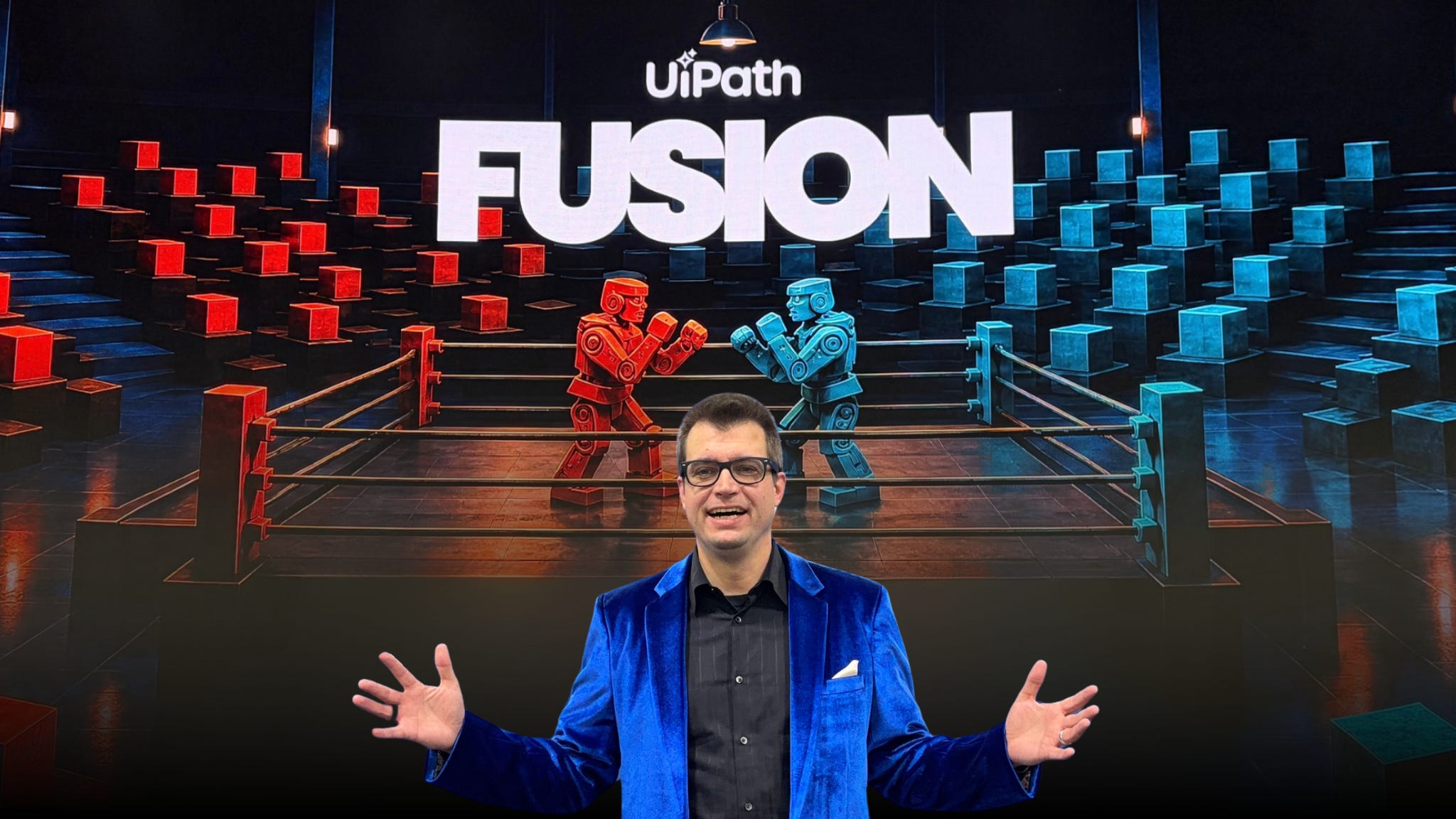
I attended UiPath FUSION in Las Vegas alongside automation and AI leaders from across industries. Between the keynotes, the customer panels, and the conversations with attendees, one message kept coming back: agents are easy to demo, but production is hard. The difference is whether the agent knows how your business actually runs, who can decide what, and what happens when the work doesn't follow the happy path. Most leaders I talked to have felt this already. Here’s what FUSION means for business leaders, and how to use agents and automation in 2026.
Disclosure: UiPath paid for my travel and sponsored this article. Views are my own.
When Process Risk Compounds, Automate Wisely
UiPath’s founder and CEO, Daniel Dines, said in his keynote that the hard part of enterprise AI isn't the intelligence, but having an accurate, up-to-date map of how a process runs. An off-the-shelf AI model doesn’t know what a payment approval means in your company, who may sign it, or what an auditor will ask for a year from now. Granting an AI agent authority without context leads to future incidents.
Accuracy degrades exponentially with the number of steps. If each step in a multi-step agentic process is right only most of the time, the chance that the entire chain is right drops exponentially with every additional step: 90% *90%* 90% = 72.9%.
Impressions from UiPath FUSION
By combining deterministic, probabilistic, and human capabilities, each does what it does best. One leader framed it as “deterministic first, probabilistic where needed, and agentic fenced in with tight guardrails as much as possible.” Michael Atalla, CMO at UiPath, put it even more simply on stage: “Don’t use intelligence for something that doesn’t require it.”
How to apply it: Before you approve a new agent, ask your team to mark each step of the process as deterministic, probabilistic, or human. Make anything that can be deterministic deterministic. Where a step needs an agent, define what “good” looks like and how you will test it, and scale your test automation in lockstep with your agentic rollout so that volume, capability, and governance grow together.
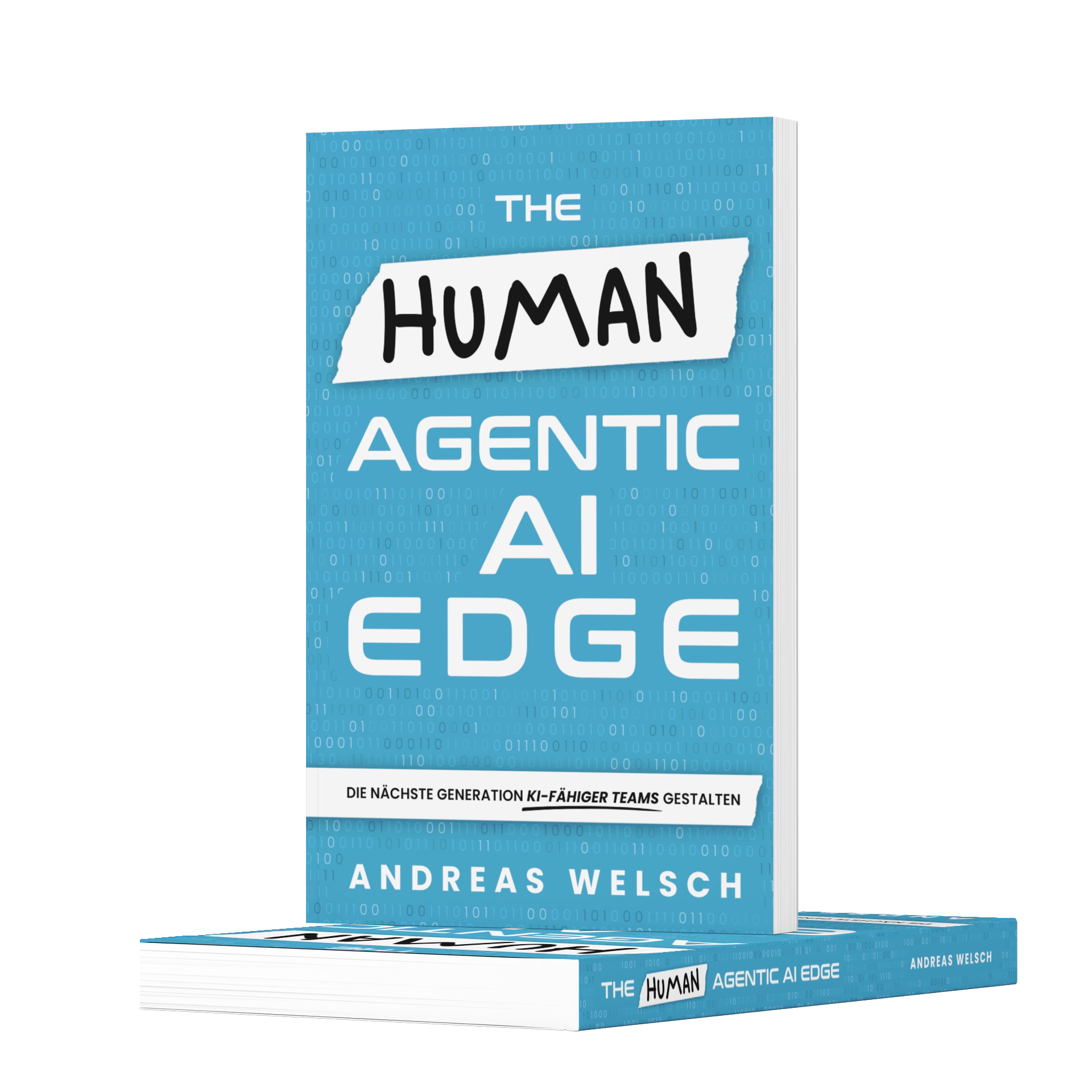
Get your copy: The HUMAN Agentic AI Edge
Organizations are racing to deploy Agentic AI, yet few are ready for the risks that emerge when employees use AI without structure, standards, or oversight.
The HUMAN Agentic AI Edge offers leaders a practical blueprint for building accountable AI-ready teams that consistently produce high-quality results. Drawing on real-world knowledge and insights from interviews with more than 50 AI leaders and experts, Andreas Welsch shows how to combine human judgment with Agentic AI capabilities to achieve the performance many organizations expect but rarely deliver. This book prepares you to shape the next generation of AI-ready teams delivering high-quality results with high accountability.
The most important announcement at FUSION was a new way to capture process context. UiPath introduced the Map of Work, a governed, living description of how a process actually runs. This Map includes the rules, the exceptions, and the judgment calls that rarely get written down. It lives in your tenant, is read by people and agents alike, and serves as your organization’s own account of its work:
Rules and policies are written so that a machine can check them (e.g., an invoice must match a purchase order and a goods receipt before payment, and the approver is never the requester).
Experienced people's judgment is included at every step, for example, the supplier whose variances are always fine, or the precedent for expediting a part when a service-level agreement is at risk.
A Decision Ledger that records who decided what, based on which evidence and rule version. The Ledger keeps the Map current by turning production decisions into proposed updates that an accountable owner approves.
To build and maintain the Map, UiPath launched UiPath Cartographer. Cartographer gathers evidence from documents, systems, and interviews and drafts the Map, with every fact carrying its source and its verifier. When two people give different answers, it surfaces the contradiction and asks which one is right, because, averaging two answers produces a third that nobody gave.
A senior automation leader at a logistics company described the impact: “By using a process map, we could have a common conversation with the business.” Comparing the documented process to what was actually happening in operations moved the discussion from automating tasks to automating processes end to end.
Process Atlas within UiPath Cartographer gives leaders three ways to start: use prebuilt maps for standard processes, customize templates where your processes vary, or build your own maps for the processes that make your business different. 83 expert-attested processes across seven industries and 25 process areas are available today to help jumpstart your journey.
How to make it your advantage: Name an accountable owner for each process you plan to put agents into: no accountable Map owner, no agentic deployment. If nobody in your organization will sign their name to how a piece of work should run, you are not ready to let software run it.
What Surprised Me the Most
While most vendors and conference attendees talk about job displacement and tiptoe around the impact of automating tasks and processes, the conversations at FUSION were surprisingly mature and technical. It was far less about “should we, or should we not?” and much more about deciding the right mix of available capabilities spanning deterministic, probabilistic, and human decision-making (which, in itself, is probabilistic).
Become an AI Leader
Join my bi-weekly live stream and podcast for leaders and hands-on practitioners. Each episode features a different guest who shares their AI journey and actionable insights. Learn from your peers how you can lead artificial intelligence, generative AI, agentic AI, and automation in business with confidence.
October 27 - Walter Schmidli (VP of Paid Social at CMI Media Group) will talk about how leading brands remain discoverable as Agentic Commerce rises in popularity. [More details to follow on my LinkedIn profile…]
November 10 - Stefano Osteria (Global Vertical Leader, Logistics and Warehouse Management at Belden) will share how leaders must keep warehouse management and logistics in lockstep with Agentic Commerce innovation in the front office. [More details to follow on my LinkedIn profile…]
November 17 - Jess Graham (CEO and Founder of Banquet) will be on the show to discuss which channels your brand needs to own to retain the buying context in Agentic Commerce. [More details to follow on my LinkedIn profile…]
December 01 - Wayne Butterfield (Fractional Chief AI Officer) will share how companies can leverage Agentic AI for customer support to close the loop of Agentic Commerce. [More details to follow on my LinkedIn profile…]
December 15 - Jon Reed (Industry Analyst & Co-Founder of diginomica) and I will close out the year with a review of the biggest topics in the mirror, and the most impactful ones ahead. [More details to follow on my LinkedIn profile…]
Watch the latest episodes or listen to the podcast