



How much time do you spend on tasks that need to be done but you’re not adding value doing them? I reached a tipping point in my business earlier this year. I am the CxO of my business, and I started feeling the weight of wearing all the hats in my business. If only I could better scale the 24 hours in my day.
I asked myself if I should hire and pay someone to run all these operational tasks for me. I deliberately answered it with no every time I contemplated my options. For the past three months, I’ve been building and expanding my multi-agent business operating system instead.
I decided to find out for myself how much I could rely on AI agents to do the work with increasing autonomy, while getting the most out of my Claude Max subscription ($100/mo.). What’s become far more valuable than the value these agents create for my business are the learnings along the way. In this article, I share both.
Defining the Agentic Team and Roles
Initially, I started with two agents to validate the idea: a chief of staff who orchestrates and dispatches tasks to other agents, and a business developer who acts as a specialist who searches the internet for business opportunities.
The team quickly grew to include a marketer, a producer, an editor, an analyst, and additional roles for finance and legal. My curiosity and ability to build them has increased with every agent. Just like in business, I didn’t just add a new agent for a new task. Instead, adding a new agent role requires at least two tasks within the same domain.
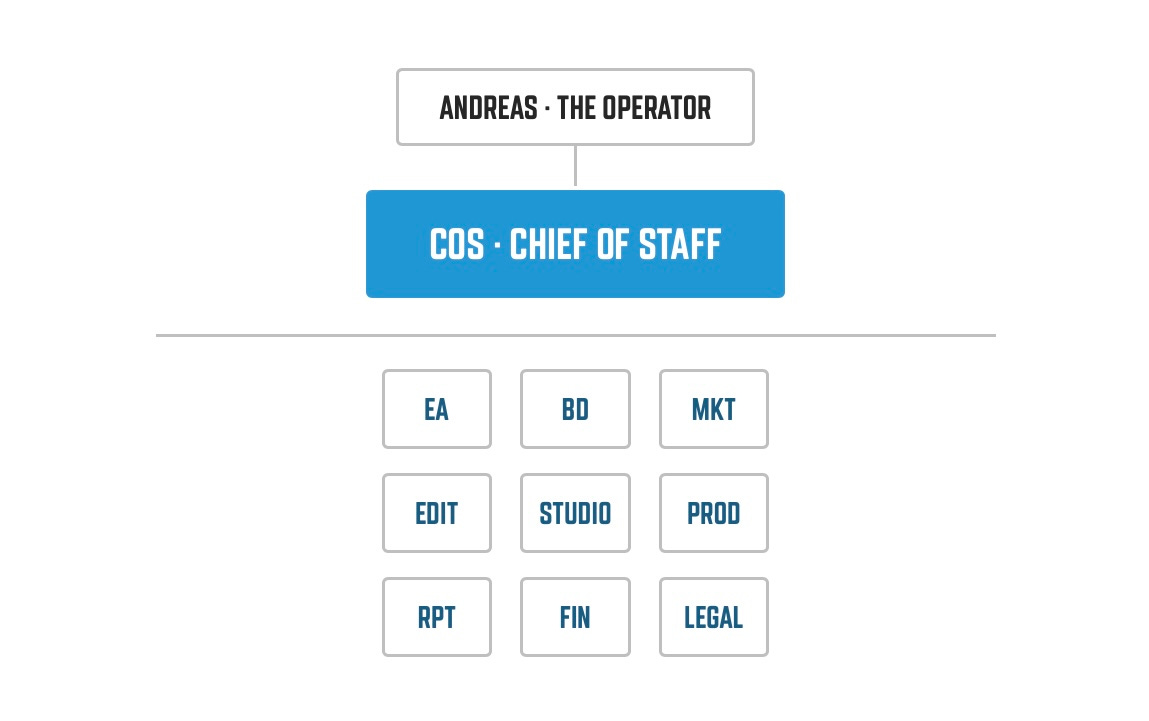
A task can be something as simple as researching prospects or optimizing a blog headline, or as complex as gathering yesterday’s book sales and ad spend to measure a campaign’s effectiveness. In Claude’s vocabulary, every repeatable task becomes a skill.
While the benefit of a single agent lies in the automation of tasks under uncertainty, a multi-agent system (or team) has dedicated roles and solves problems together. The comparison with a single professional and the founding team of a startup that has specialize roles works quite well here.
Building, Operationalizing, and Paying for the Agentic Team
Most users still use AI like like a chatbot. They ask a question, get an answer, and move on. Advanced users build skills to receive faster, more predictable results by encapsulating repetitive tasks. Pro users create single agents or schedule prompts to run in defined intervals. But I have seen very few users that consequently automate every task. Yet, automating a business needs precisely that, and it’s largely possible today.
Consequently, any repeatable task in the business should become a skill, so an agent can run it—again and again. (Now, read that again.)
Some tasks are just gathering data, like web analytics. Others build upon that data to derive insights, for example which pages moved to a higher position in the search results and why. The next layer above takes these insights and defines actions and decisions, for example, rewriting your blog posts title and description to become more discoverable. But you can’t do the latter without the foundation.
In addition to these task types, one specialist agent might need to hand off a task to another specialist, and communicate with each other. (If you’ve ever written a job description, this is the section about “This role collaborates closely with ABC on XYZ.”)
The cost of intelligence is heavily subsidized at the moment. The real cost (as measured otherwise by token cost for API calls) is multiples higher than the subscription cost of $20 or $100 per month. Increasing usage limits, such as 50% more usage for Claude Code, $250 in free credits, or a free weekly quota reset, make it enticing to build while the subscription cost is still predictable.
At the moment, the cost to orchestrate my business (in addition to the applications I use anyways) is $129 per month:
Claude Max ($100/mo.)
Database ($25/mo.)
GitHub ($4/mo.)
Even at $229/mo., the cost would justify the benefits, because it is still cheaper than an offshore virtual assistant services charging $600-2,500/mo. to complete tasks that Claude can already automate.
Example: A media agency asks for the latest stats of a sponsored post I published four weeks earlier. It’s a common request I receive, and it usually takes me 5-10 minutes to find the post, open it in a browser, take a screenshot, draft a reply, and attach the screenshot. So, I built a Claude skill and added it to my reporting agent’s charter. The agent now pulls the data by browsing to the live post and getting the analytics from the raw HTML code. It then drafts a reply that’s ready to send. The speed and the ability to confidently hand this task to an agent shows the value of an agentic team. But how does the reporting agent even know which post to query? Once I sign a contract, my legal agent reads the contract and extracts and saves the deliverables in the database. Once a post goes live, I send the chief of staff agent the link, which it records.
Learnings That Outweigh the Cost
What started with 2-3 agents in Claude Cowork and an Airtable database as a backend and message bus has quickly evolved into a team of 12 agents, a legitimate cloud database that handles the transaction volume and growth, and a dashboard that shows the key business metrics.
I only add a new agent to the team when the scope is uniquely different from the others’ and when at least two tasks fall into that agent's scope. But with every agent I have added, the complexity of the overall system and the maintenance effort have increased.
It’s a good case of organizational leadership and organizational design. Expanding the span of control of 6-7 agents to a larger number quickly becomes hard to manage. You will eventually need to augment your chief of staff’s role or add a layer of agentic managers that manage specialist subagents.
Expanding my agents’ scope by building new skills has quickly become a daily task, like building and growing an all-human team (but slightly worse in a few respects). Using Claude to expand the estate of agents often introduces gaps and inconsistencies that need human review or decision before promoting them from draft to production. If a change will be applied to all the agents on the team, I want to review and explicitly approve it.
But the very system I am building to take work off my plate has quickly started putting more work back on it. I find myself missing context about proposed changes or Claude presenting options where I’m unclear about the implications. Yet, I have little time to drill deep into each of them. Information overload quickly leads to following the “recommended” option to clear it off my plate.
I've recently spoken with a handful of peers who have built similar agentic teams, and they shared similar observations. The time for completing a business task shifts to the time spent for maintaining or correcting the agents. Agents need to maintain several layers of memory and context, and promote memory items from temporary to permanent, and much more. Having multiple agents coordinate with each other, while managing their state, status, and results is anything but trivial. By the way, commercial software vendors are likely facing the same challenges despite being better resourced than a solopreneur business.
Just like with all-human teams, you will need to delegate as a leader of an agentic team. Delegating requires setting clear, measurable goals and defining how you evaluate whether the goal has been achieved and if the result is satisfactory or needs rework.
Example: Throughout my career I've led teams of different sizes, with diverse skillsets, and varying levels of experience. Managing a team of agents reminds me of managing a team of summer interns that require a significant amount of your time to guide them, and review, tweak, and correct the output they create. If you do it right (and are willing to make that investment), the time you spent guiding that team will pay off in the long run. But right now and right here, it’s still taking a lot more time than the Silicon Valley tech bros are making you believe.
Summary
Amid the AI hype and doom and gloom of the jobpocalypse, I set out to test the boundaries of running an agentic business myself. At the moment, it’s a work in progress, and tweaking is as continuous and needed as the nature of business changing itself. When tasks can reliably and repeatedly be automated, agentic systems provide clear cost and time savings. But to realize the vision of fully agentic operations, businesses will continue to require knowledgeable staff that can maintain the daily drift.
Looking to maximize the value from your AI subscription with a team of AI agents? Book a consultation to fast-track your AI adoption.
Become an AI Leader

Join my bi-weekly live stream and podcast for leaders and hands-on practitioners. Each episode features a different guest who shares their AI journey and actionable insights. Learn from your peers how you can lead artificial intelligence, generative AI, agentic AI, and automation in business with confidence.
Join us live
September 29 - Maarten Albarda (Leading Marketing Consultant for Marketing Operations) will share how companies can advertise to AI agents.
October 13 - Michael Nevski (Consumer Market Intelligence Expert) will discuss the prerequisites for AI agents to complete financial transactions on their users’ behalf.
October 27 - Walter Schmidli (VP of Paid Social at CMI Media Group) will talk about how leading brands remain discoverable as Agentic Commerce rises in popularity. [More details to follow on my LinkedIn profile…]
November 10 - Stefano Osteria (Global Vertical Leader, Logistics and Warehouse Management at Belden) will share how leaders must keep warehouse management and logistics in lockstep with Agentic Commerce innovation in the front office. [More details to follow on my LinkedIn profile…]
November 17 - Jess Graham (CEO and Founder of Banquet) will be on the show to discuss which channels your brand needs to own to retain the buying context in Agentic Commerce. [More details to follow on my LinkedIn profile…]
December 01 - Wayne Butterfield (Fractional Chief AI Officer) will share how companies can leverage Agentic AI for customer support to close the loop of Agentic Commerce. [More details to follow on my LinkedIn profile…]
December 15 - Jon Reed (Industry Analyst & Co-Founder of diginomica) and I will close out the year with a review of the biggest topics in the mirror, and the most impactful ones ahead. [More details to follow on my LinkedIn profile…]
Watch the latest episodes or listen to the “What’s the BUZZ?—AI in Business” podcast
Upcoming events
Join me or say hello at these sessions and appearances over the coming weeks:
October 07 - Hosting O’Reilly’s AI Superstream, Securing Agentic Systems: Safeguard the next generation of AI agents live show.
October 14 - Speaking at Mastering CX: AI Agents by CX Network, virtual.
October 26-28 - Attending Gartner HR Symposium/ Xpo™ in Orlando, FL.
December 09-10 - Attending The AI Summit in New York, NY.
Follow me on LinkedIn for daily posts about how you can lead AI in business with confidence. Activate notifications (🔔) and never miss an update.
Together, let’s turn hype into outcome. 👍🏻
—Andreas