For twenty-five years, the commercial web has run on a single mechanic. A person types a query, scans a ranked list, opens several tabs, compares, asks for a quote, and eventually buys. Search optimization, display advertising, conversion tuning, and the reporting stacked above them all assume a human hand on the mouse. That assumption is now being removed from underneath the structure.
The legal record already registers the pressure. OpenAI and Perplexity launched their agentic web browsers, Atlas and Comet, in 2025. In November of that year, Amazon sued Perplexity, alleging that AI agents like Comet directly access its online store, thereby rendering its advertising useless. In March 2026, Amazon won the suit. The dispute names the problem precisely: an intermediary that reads on a customer’s behalf breaks a business model that bills for attention it can no longer deliver.
Three consequences follow for anyone with something to sell. Demand arrives through software rather than through browsing behavior. Advertising keeps its budget and changes its target. And only a portion of the work inside your organization is ready to be handed to an agent at all. To explore this emerging capability, I invited Michael Carroll (Strategic Advisor at LNS Research) to join me on “What’s the BUZZ?” Here’s what we talked about…
When the Orchestration Moves to the Agent
The shift underneath all of this is a move from a click-based architecture to an intent-based one. Under the click-based model, the buyer performs the orchestration personally: searching, shortlisting, requesting quotes in whatever format each supplier insists on, and pressing for a discount. Reasoning that runs close to the buyer inverts that arrangement. The agent performs the orchestration, and the buyer supplies only the intent. The components are already ordinary. A model that plans across several steps, tools that submit forms and read the replies, and the patience to run the same comparison across a dozen suppliers are available to any competent buyer today. What stays with the buyer is the harder half of the job, which is working out why they want what they want.
A page written to hold a person’s attention and a page written to answer an agent’s question are not the same artifact. If an agent cannot extract your price band, your terms, your lead times, and verifiable proof of each, you do not lose the comparison. You never enter it. That is not a ranking problem, because no ranked list sits in front of anyone. It is a distribution problem, and it belongs to whoever owns your revenue number, not to whoever owns your website. A measurement problem arrives alongside it. When the decisive event is an agent’s comparison rather than a human’s click, the metric that matters is whether your offer survives that comparison, and your dashboard almost certainly cannot observe that event at all.
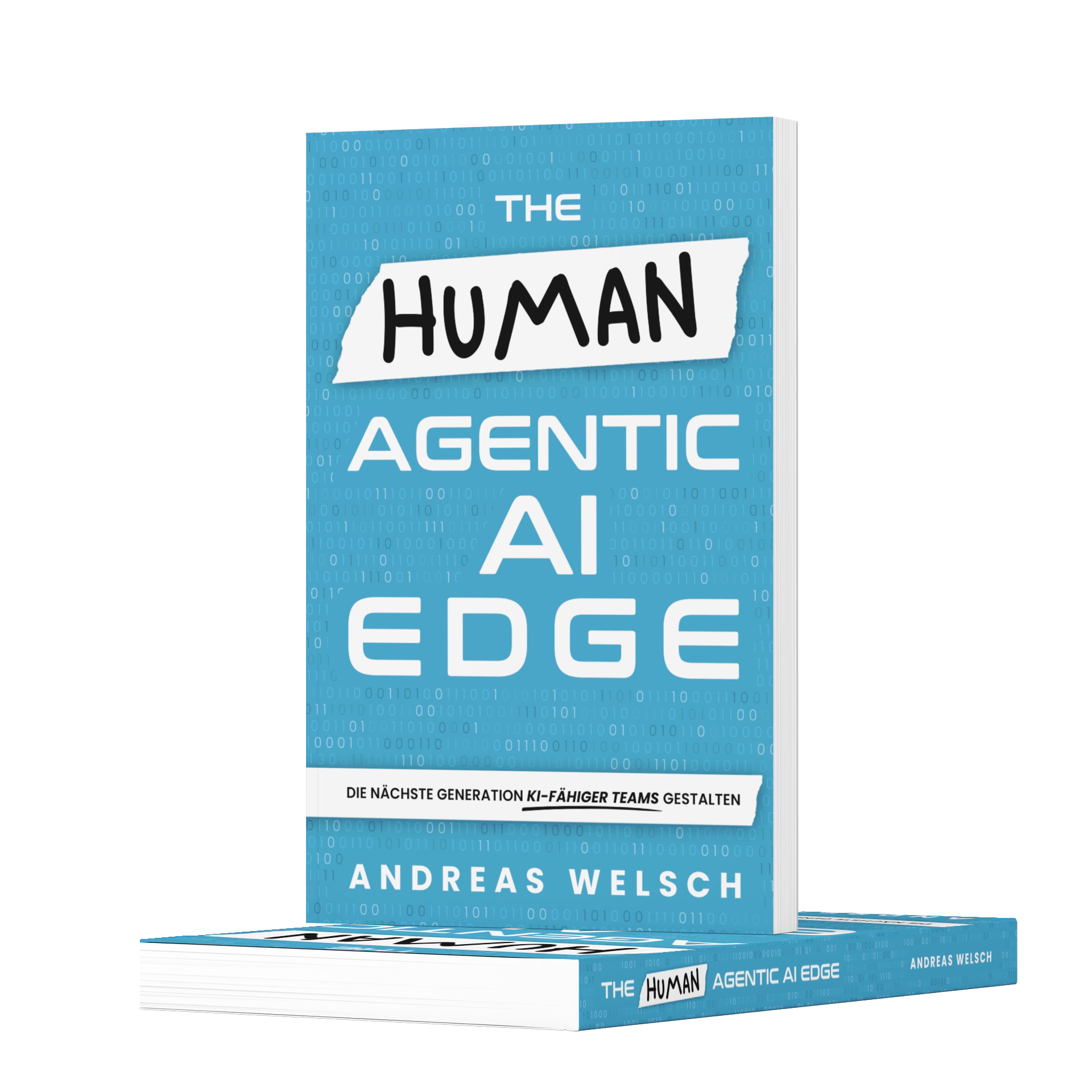
Get your copy: The HUMAN Agentic AI Edge
Organizations are racing to deploy Agentic AI, yet few are ready for the risks that emerge when employees use AI without structure, standards, or oversight.
The HUMAN Agentic AI Edge offers leaders a practical blueprint for building accountable AI-ready teams that consistently produce high-quality results. Drawing on real-world knowledge and insights from interviews with more than 50 AI leaders and experts, Andreas Welsch shows how to combine human judgment with Agentic AI capabilities to achieve the performance many organizations expect but rarely deliver. This book prepares you to shape the next generation of AI-ready teams delivering high-quality results with high accountability.
Where Advertising Lands When the Buyer Has No Emotions
The reflexive assumption is that agents kill advertising. The more defensible reading is that advertising survives with its budget largely intact and its purpose rewritten, because people still watch television, still scroll, and still listen to streaming audio. What changes is the job an advertisement does. Advertising has always run on an emotional mechanism: a want or an absence the viewer did not know they felt until the spot named it. An agent offers no such surface, because it evaluates against constraints. Persuasion therefore moves one step earlier in the chain, onto the human who sets the preference, and the advertisement’s task becomes biasing that person into telling their agent what to prefer. That is a narrower and more measurable objective than building general affection, and harder to fake.
Marketing organizations should attach a second objective to the next creative brief, because a brief written to produce a feeling now also has to produce an instruction: a viewer who finishes an ad able to name your product to their agent is worth more than one left merely warm toward your brand. And watch the contest for influence continue past the human into the stack, because whoever supplies the reasoning agent, whoever owns the surface the ad runs on, and whoever operates the trust layer between them together hold a position difficult to attack from outside. Two of those three corners already belong to the incumbents who dominated the click economy, which tells you where the leverage will sit.
Pricing sits beside all of this. Variable pricing based on inferred willingness to pay has existed for years with little scrutiny, largely because individual buyers could not detect it. An agent shopping the same product across suppliers, repeatedly and on behalf of many people, makes that variation legible. If you price this way, open the internal debate about defensibility on your own schedule, not on an agent’s.
Sorting the Work Into Intermediation and Mediation
Separating the things organizations are largely built to do is a practical way to decide where autonomy is safe. Intermediation is the translation and transfer of information: taking a fact out of one system or department and making it usable in another. Mediation is the transformation of something from one state to another, and it requires approval or permission before it can happen.
Intermediation is rules-based and largely reversible. A misrouted document can be rerouted, a mistranslated field corrected, and the cost of an error is rework rather than liability. Autonomy arrives here first, and the business case needs little argument.
Mediation is a different proposition, because it carries responsibility, and responsibility does not transfer to a machine. It transfers to you, the person who authorized it. That single fact settles most arguments about how quickly to proceed. A process that changes a price, grants a credit, signs a commitment, releases a batch, or alters a customer’s entitlement needs defensibility before it needs autonomy.
Defensibility means something stricter than the interpretability tooling most organizations reach for first. A post-hoc explanation is a report generated after a decision to describe it, and a report written after the fact is exactly what the next party to a dispute can argue with. What holds up instead is a causal chain of reasoning, in the tradition Judea Pearl established: an understanding of what is true about the world, an understanding of what an action would make true, a hypothesis, an action taken, and the evidence of the outcome read back against it. That is an architecture rather than a report, and “causal” is not the same as “deterministic”.
Summary
Three things change when the buyer on the other side is software. Demand arrives through a system that reads rather than browses, which turns legibility into a distribution question rather than a website question. Advertising keeps its budget and shifts its target to the human who sets preferences, which changes the creative objective and what needs to be measured. And only reversible work is ready for autonomy today, while everything carrying responsibility waits on a chain of reasoning you have not yet built.
If your customer’s agent evaluated your business today, on your current pages, prices, and terms, what would it conclude, and would you even know that it had happened?
Equip your team with the knowledge and skills to leverage Agentic AI effectively. Book a consultation or workshop to accelerate your company’s AI adoption.
Join my bi-weekly live stream and podcast for leaders and hands-on practitioners. Each episode features a different guest who shares their AI journey and actionable insights. Learn from your peers how you can lead artificial intelligence, generative AI, agentic AI, and automation in business with confidence.
October 13 - Michael Nevski (Consumer Market Intelligence Expert) will discuss the prerequisites for AI agents to complete financial transactions on their user’s behalf. [More details to follow on my LinkedIn profile…]
Watch the latest episodes or listen to the podcast
A lot of being visible to commerce agents comes down to building bot-friendly structured page designs, and tools like Shopify are making this much easier for smaller, non-technical sellers. The biggest challenge I see is ensuring that agents have some way to make reasonable product recommendations and tell reputable brands from fake, scammy ones.
I'd push back slightly on the framing that this removes the human hand entirely. In every AI-native product I've built, the agent ends up being a filter that hands a shortlist back to a person for the final call, at least for anything above a trivial price point. The mechanic changes, but the point where trust and money actually change hands still seems to want a human in the loop. Curious whether you think that holds as agents get better at judging quality, not just matching specs.




A lot of being visible to commerce agents comes down to building bot-friendly structured page designs, and tools like Shopify are making this much easier for smaller, non-technical sellers. The biggest challenge I see is ensuring that agents have some way to make reasonable product recommendations and tell reputable brands from fake, scammy ones.
I'd push back slightly on the framing that this removes the human hand entirely. In every AI-native product I've built, the agent ends up being a filter that hands a shortlist back to a person for the final call, at least for anything above a trivial price point. The mechanic changes, but the point where trust and money actually change hands still seems to want a human in the loop. Curious whether you think that holds as agents get better at judging quality, not just matching specs.