Most of the public argument about agentic commerce has been an argument about discovery: whether an agent can find a product, whether it will find yours, and who gets paid for attention that no longer reaches a human. The harder argument begins the moment an agent stops browsing and starts paying, and it has attracted far less attention. Yet, few are asking who is accountable when the money moves wrongly.
To explore how AI agents will transact on our behalf, I invited Michael Nevski (Consumer Payment Market Intelligence Expert) to join me on “What’s the BUZZ?” Here’s what we talked about…
Who Authorizes When Nobody Presses Buy
The short answer is worth repeating inside your own teams: the issuer still authorizes. The bank that issued the card reviews the transaction and its credentials in that instant, exactly as it does when a person taps a phone at a terminal. The agent does not become the payer. It becomes a new kind of instruction, arriving on a rail designed for a person to press a button, which is why the plumbing can look finished while the important parts are missing.
The identification layer is further along than most leaders assume. An agent verification protocol already exists, so a network can confirm that the agent placing an order genuinely belongs to the customer it claims to represent, with credentials that can be stored, tokenized, and verified. What has not been built is everything downstream of that message. Privacy, security, chargebacks, and disputes remain unresolved, and until they are settled, agent-initiated activity stays a set of hypothetical use cases rather than production volume.
That gap matters because your customers have already decided whom they will blame, and their answer does not align with what your contracts say. When an agent-initiated purchase goes wrong, responsibility is assigned first to whoever provided the agent, then to the AI developer behind it, and then, notably, to the customer’s own instruction. The payment networks come last by a wide margin. Perceived liability and contractual liability are different, and the perceived one shows up at your service desk.
Run one plausible agent-initiated order through your dispute process this quarter as a tabletop exercise. Establish where your record of customer intent lives, which of your teams issues the credit, and what a customer claim that no person authorized the order does to your chargeback ratio. Answering that now costs you a meeting; answering it after the volume arrives costs you a quarter of refunds.
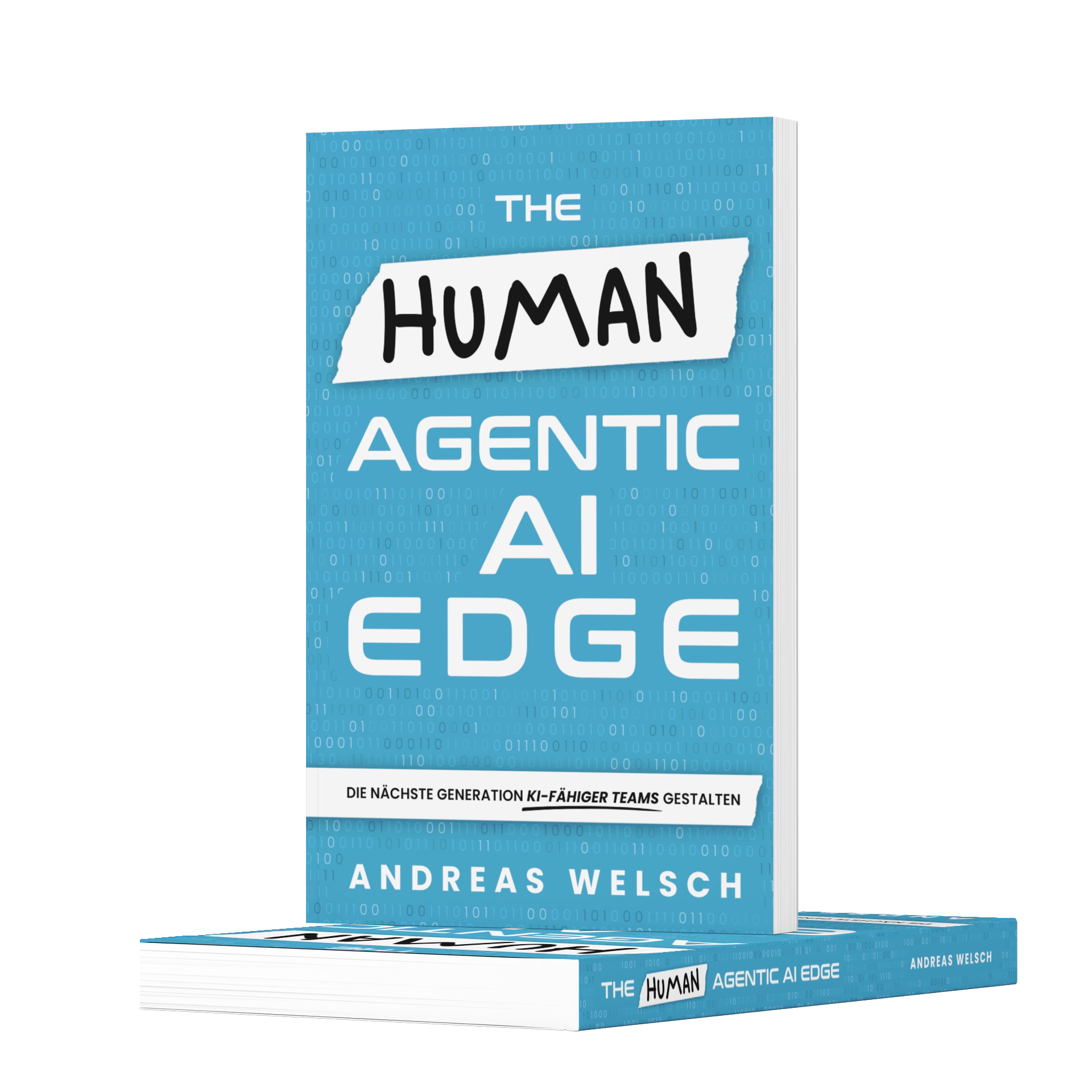
Get your copy: The HUMAN Agentic AI Edge
Organizations are racing to deploy Agentic AI, yet few are ready for the risks that emerge when employees use AI without structure, standards, or oversight.
The HUMAN Agentic AI Edge offers leaders a practical blueprint for building accountable AI-ready teams that consistently produce high-quality results. Drawing on real-world knowledge and insights from interviews with more than 50 AI leaders and experts, Andreas Welsch shows how to combine human judgment with Agentic AI capabilities to achieve the performance many organizations expect but rarely deliver. This book prepares you to shape the next generation of AI-ready teams delivering high-quality results with high accountability.
The ceiling a customer places on an agent’s spending is the most honest available measure of how much that customer trusts the agent, and today that ceiling is low. Consumers will currently delegate only small sums, the sort that can be lost without much consequence. Enthusiasm and anxiety are also not spread across two different populations: concern about oversight and reliability is widespread and overlaps heavily with the belief that this technology will make daily life easier, so the early adopter and the skeptic are frequently the same person.
That points to where you should start. Begin where being wrong is cheap, which in practice means replenishment: the staples and consumables your customers already buy on a schedule, where the wrong brand or quantity is an irritation rather than a loss. Reversibility is the qualifying criterion, not basket value.
The same logic governs personal data. Blanket requests for location history or browsing behavior are refused by almost everyone, while the identical request attached to a task the customer wants completed right now, such as finding a restaurant within a mile in the next hour, is granted far more readily. Customers price their data against a specific job. Ask at the moment of the task rather than in a permissions screen you present once at sign-up.
Your design brief follows from that. Give customers explicit opt-in and opt-out controls, plus a spending cap they can set themselves and change without contacting anyone. Then treat the average agent-authorized basket size as a metric you increase over several quarters, reported alongside your return and dispute rates. Plan for high-value autonomous purchases in year one, and you are building for a customer who does not exist yet.
What It Costs to Be the Agent Provider
Customers are more comfortable letting a technology provider run an agent on their behalf than letting a retailer offer the same service, once they understand how it works and who is responsible for what. The gap between the two is modest and should not be over-read, but the direction is consistent: sell your products, and leave the technology to companies whose business that is.
Set that beside where blame lands when a transaction fails, and the economics become clearer. Offering your own shopping agent means absorbing the support, refund, and reputational cost of every weak link in a chain you only partly control, including a catalog record nobody updated, a checkout step that runs slowly, and a delivery promise the agent read literally. Walmart placing Sparky inside ChatGPT is exactly that bet, made by a retailer large enough to own both the customer relationship and the failure modes attached to it. For most merchants, it is not a free extension of the storefront.
The cheaper posture is to participate in the ecosystem rather than to operate the agent inside it, and that work is concrete and available to you now. Structure your product information clearly enough that an agent can compare it like-for-like. Get your issuers to enable tokenization. Assess honestly whether your legacy systems can carry agent-initiated volume, and build a plan if they cannot. Standards such as the Universal Commerce Protocol are worth tracking closely, since openness and ecosystem adoption will determine which of them matter, and a working relationship with regulators in every market you sell in belongs on the list, too.
The customers who arrive first are the younger, digitally native segments, so choose your early test cohort deliberately rather than taking whoever happens to opt in. Whether you become an agent provider or a participant in someone else’s ecosystem is a governance decision more than a technical one, and you should write down the liabilities each choice hands you before a product review settles it by default.
Summary
Agentic commerce changes who initiates a payment while leaving authorization exactly where it has always been, with the issuer. What remains unsettled is the layer wrapped around it: disputes, chargebacks, privacy, and the accountability customers already assign, whether or not the contracts agree with them. The identification technology is closer to being ready than the commercial rules are.
The market will therefore grow from the bottom. Customers delegate small, reversible amounts first and hand over more only as you demonstrate reliability, which makes the low-regret replenishment basket the right place to start, and patience a design requirement.
The last decision is the expensive one. Running the agent and being reachable by one are different businesses with different liabilities, and the first is priced based on support tickets, refunds, and reputation rather than on engineering hours. Amazon’s win against Perplexity established that a merchant can shut the door on an agent entirely; the harder question is what it costs to hold that door open, and on whose terms.
If an agent placed an order with your company tomorrow and spent more than the customer intended, which team would own the answer when that customer calls?
Equip your team with the knowledge and skills to leverage Agentic AI effectively. Book a consultation or workshop to accelerate your company’s AI adoption.
Join my bi-weekly live stream and podcast for leaders and hands-on practitioners. Each episode features a different guest who shares their AI journey and actionable insights. Learn from your peers how you can lead artificial intelligence, generative AI, agentic AI, and automation in business with confidence.
November 17 - Jess Graham (CEO and Founder of Banquet) will be on the show to discuss which channels your brand needs to own to retain the buying context in Agentic Commerce. [More details to follow on my LinkedIn profile…]
December 01 - Wayne Butterfield (Fractional Chief AI Officer) will share how companies can leverage Agentic AI for customer support to close the loop of Agentic Commerce. [More details to follow on my LinkedIn profile…]
December 15 - Jon Reed (Industry Analyst & Co-Founder of diginomica) and I will close out the year with a review of the biggest topics in the mirror, and the most impactful ones ahead. [More details to follow on my LinkedIn profile…]
Watch the latest episodes or listen to the podcast