For the past few months, I’ve been connected to AI-related workforce decisions across various levels and stakeholder groups. Whether it’s workshops and leadership development courses for mid-sized manufacturers and industry giants, AI literacy training for solopreneurs, or hands-on AI labs for undergraduate students, everyone is trying to make sense of what’s here and what’s to come with AI.
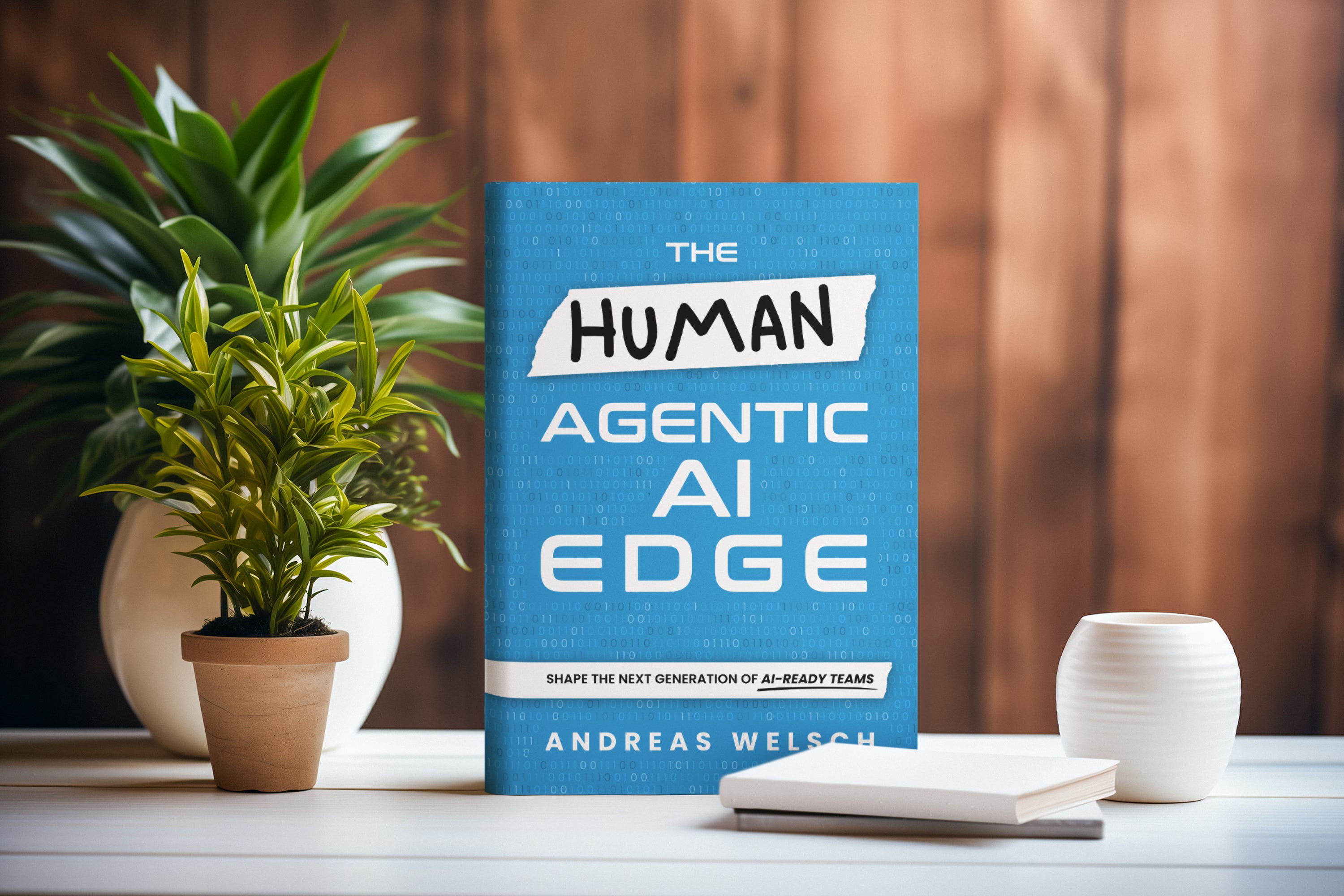
Three articles published in the past week address three connected topics I cover in my new book, The HUMAN Agentic AI Edge (available Feb 25). As businesses use more AI across business functions, processes, and applications, the dynamic of human-AI interaction changes. Delegating does not equal done, and done does not equal done well. Similarly, slowing entry-level hiring trades present-day cost savings against future growth, and knowledge ownership moves into focus when data is captured and provided to enterprise AI systems as part of normal operations. Here’s where to start…
Balancing AI-Driven Efficiency and AI-Induced Burnout
Most leaders and professionals I work with still use AI tools like a better Google search: ask a question, get an answer. Ask another question on a different topic, get another answer. They don’t use it to the full extent of its capabilities and of their own. On the other hand, many professionals in my network regularly use AI. For them, AI’s novelty evolves much faster. Yet, the pendulum is swinging back from “all-in” to “everything in moderation.” You might also say that this group has been blazing through the AI maturity curve.
Creating anything digital is a mouse click or a voice command away, but then come the filtering, prioritizing, and reviewing bottlenecks that AI cannot solve (yet). For that group, the stretch between useful AI and an overwhelming flood of information acts like a review tax. When AI takes over the majority of tasks that carry a low cognitive load (finding time on five people’s calendars, sending out meeting minutes, etc.), the ones that carry a high cognitive load tire you out.
As the introduction of AI in a business changes the definition and scope of roles, leaders need to ensure a balance between three kinds of tasks of varying load:
Peak tasks (high): negotiation, high-stakes decisions, conflict resolution, and strategy, such as leading a pricing negotiation with a strategic customer, resolving a cross-functional delivery dispute, or presenting to executives.
Flow tasks (medium): drafting, structured analysis, and problem-solving with clear boundaries, such as preparing a customer briefing before a quarterly business review or analyzing performance trends to identify improvements.
Recovery tasks (low): organizing materials, closing action items, updating trackers, and administrative follow-through, such as finalizing CRM notes after a sales call or preparing agendas for recurring team meetings.
Read more about it in the chapter Leading Work Across Humans and AI Agents in The HUMAN Agentic AI Edge.
Without active moderation and guidance, the effects highlighted in AI Doesn’t Reduce Work—It Intensifies It (Harvard Business Review; Feb 09, 2026) provide a glimpse. The three that stand out to me:
Employees take on more tasks beyond their core domain as AI handles more mundane tasks.
Employees become managers who delegate tasks to teams of AI agents and need to give feedback or correct AI’s mistakes.
Employees fill the time they’ve saved with more work, which can lead to burnout.
Thank you for reading The AI MEMO. Feel free to share it with your network.
Organizations are racing to deploy Agentic AI, yet few are ready for the risks that emerge when employees use AI without structure, standards, or oversight.
The HUMAN Agentic AI Edge offers leaders a practical blueprint for building accountable AI-ready teams that consistently produce high-quality results. Drawing on real-world knowledge and insights from interviews with more than 50 AI leaders and experts, Andreas Welsch shows how to combine human judgment with Agentic AI capabilities to reach the level of performance many organizations expect but rarely achieve. This book prepares you to shape the next generation of AI-ready teams delivering high-quality results with high accountability.
What’s Your Future Leadership Bench, and Who’s on It?
Since Dario Amodei, CEO of AI lab Anthropic, sounded the alarm in 2025 that unemployment might rise sharply in the coming years due to AI, many CEOs outside the tech industry have slowed hiring for entry-level roles in anticipation of AI’s growing capabilities. Swedish fintech Klarna has become a poster child for reversing course on this topic after its leaders realized that AI couldn’t handle all support requests or deliver sufficient customer satisfaction.
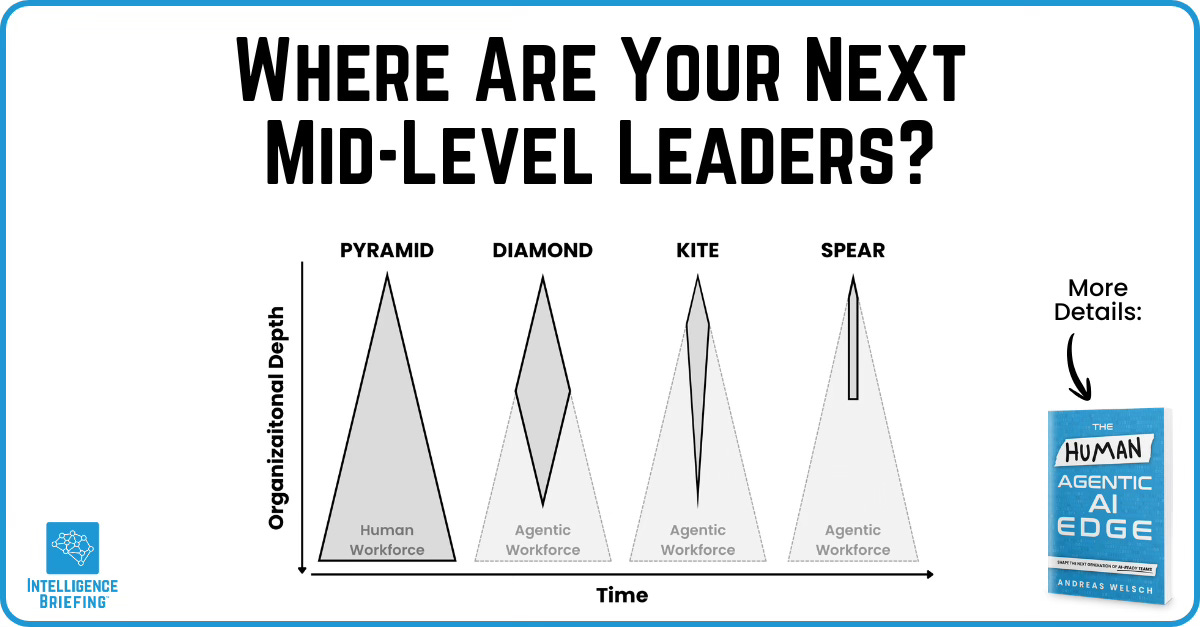
But slowing or stopping hiring because I can take on more tasks of a single role misses the real complexity. Roles held by humans are much more complex than the sum of a handful of tasks. While AI agents are expected to fill gaps in skills and execution in an Agentic Workforce, over time, a company’s organizational structure will evolve from a pyramid to a diamond, kite, or even a spear (for frontier firms).
Evolution of Organizational Structures
Hiring fewer early-in-career individuals because AI will take on more work has two major flaws:
CEOs optimize the cost of delivering the status quo. (No business survives by standing still, though.)
Your talent bench to succeed your current leaders shrinks, and so does the human knowledge within your organization.
Instead of shrinking their workforce, organizations actually need to cross-train their team members in other business functions or divisions.Skill sets need to evolve from deep experts (I-shaped skill profiles) to generalists with one specialization (T-shaped profile) and generalists across several specializations (M-shaped profile) through:
Job shadowing (1-5 days) enables a team member to observe and support colleagues in another role or department.
Project assignments (1-3 months) enable team members to contribute to a cross-functional initiative with a defined scope and limited duration as part of their day-to-day role.
Job rotation (3-6 months) offers employees the opportunity to move through different roles and departments as part of a structured, time-bound process.
Job swaps (6-12 months) let two employees exchange roles for a limited period.
Read more about it in the chapter titled Designing Your Organizational Structure for AI Readiness in The HUMAN Agentic AI Edge.
A case in point is IBM’s recent reversal on hiring, tripling hiring for in-demand, entry-level AI roles. In 2023, IBM’s CEO, Arvind Krishna, shared that the company could replace 7,800 jobs (30% of the company’s corporate roles) with AI. Now, IBM’s CHRO was quoted saying: “And yes, it’s for all these jobs that we’re being told AI can do.“ IBM to Triple Entry-Level US Hiring With Roles Recast for AI Era (Bloomberg; Feb 12, 2026; paywall) goes into more detail. Do take note.
Conclusion
While AI use is on the rise, so are its effects. AI enables users to accomplish more in the same time, but it also introduces a new review burden. As roles evolve with the introduction of AI, leaders need to intentionally design roles that balance high-, medium-, and low-cognitive tasks to avoid employee burnout.
As business leaders anticipate the promised gains of AI and Agentic AI, slowing their company’s hiring for short-term cost savings will impact the talent bench. Eventually, hiring capable leaders will be costly and impact ramp-up time. Leaders should revisit their workforce strategy and strike a balance between short-term optimization and long-term benefits.
Lastly, when employees’ knowledge and decisions are digitally captured, companies could still benefit from using a team member’s digital replica even when that team member has left the company. Workers Are Afraid AI Will Take Their Jobs. They’re Missing the Bigger Danger. (The Wall Street Journal; Feb 15, 2026) highlights several emerging questions about knowledge and ownership that you will also find in The HUMAN Agentic AI.
Join my bi-weekly podcast for leaders. Each episode features a different guest who shares their AI journey and actionable insights. Learn from your peers how you can lead artificial intelligence, agentic AI, generative AI & automation in business with confidence.
March 31 - Elise Neel (SVP of Global Strategy & Strategic Partnerships at Panasonic) will share how to scale executives’ time with specialized agents. [More details to follow on my LinkedIn profile…]
Upcoming events
Join me or say hello at these sessions and appearances over the coming weeks:
February 23-26 - Enterprise Architect Forum in Newtown Square, PA. Book launch & book signing: The HUMAN Agentic AI Edge.
March 09-11 - Attending Gartner Data & Analytics Summit in Orlando, FL.
March 04 - Live Stream: Northwestern Industrial Resource Center in Erie, PA.
March 24 - Speaking at PEX Network’s OPEX All Digital conference.
March 25 - Speaking at Driving Impact for Manufacturers, Erie, PA.
April22-23 - Keynote at More than MFG Expo in Cincinnati, OH.
November 10-11 - Technology Sourcing in Chicago, IL.
Follow me on LinkedIn for daily posts about how you can lead AI in business with confidence. Activate notifications (🔔) and never miss an update.
Together, let’s turn hype into outcome. 👍🏻 —Andreas
Thanks for reading The AI MEMO! Subscribe to receive new posts.
Workforce strategy is where most organizations are still flying blind with AI. The gap I keep seeing is between leadership's ambition ("transform everything") and the actual change management required to make it stick. The companies getting this right are the ones treating AI adoption as a people problem first and a technology problem second.





Workforce strategy is where most organizations are still flying blind with AI. The gap I keep seeing is between leadership's ambition ("transform everything") and the actual change management required to make it stick. The companies getting this right are the ones treating AI adoption as a people problem first and a technology problem second.