Image created with ChatGPT: “Businessman riding on a unicorn through a library”
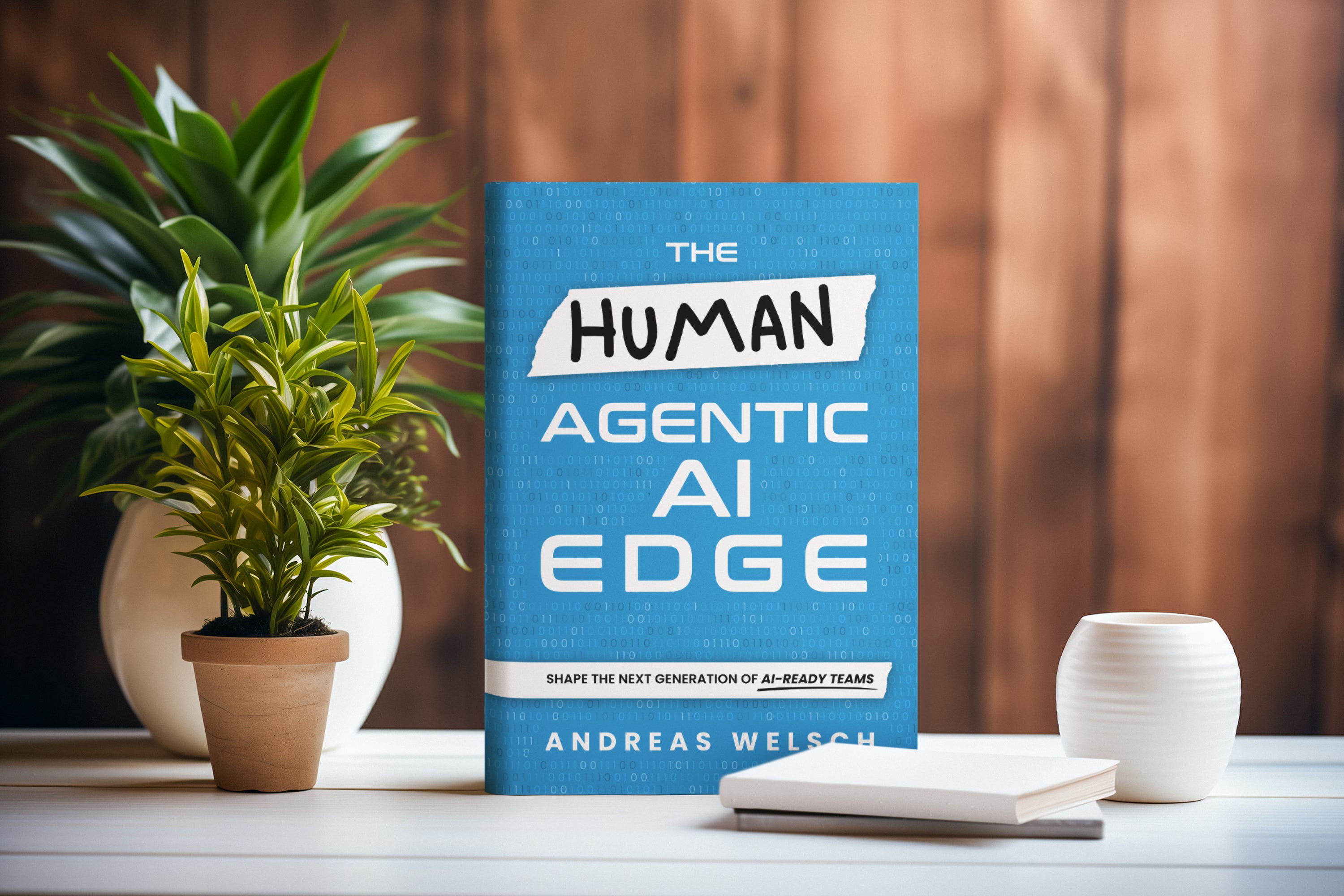
Last spring, I noticed the beginning of something that’s become a growing trend by now: More low-quality content arrived in my inbox. The half-baked drafts. The “look-this-over” proposals. It’s the new labor shift when you end up reviewing what someone else should’ve done themselves in the first place. It’s the core motivation behind my latest LinkedIn Learning course and my new book, The HUMAN Agentic AI Edge (available on Feb 25, 2026).
Writing a book about using AI without creating low-quality results (aka “slop”) wouldn’t be complete without using AI strategically at key points in the process myself. I believe that writing sharpens your thinking, which is why I’ve written the manuscript myself. But I also knew that I could use some expert support beyond my own skills to edit and refine the manuscript.
According to Forrester’s recent predictions for 2026, 55% of companies that have terminated team members due to anticipated AI-related gains will rehire for these roles (maybe even the same people!). So, what would the limits of my own AI assistants and agents be? What lessons learned would also be applicable to business? Here’s what I found…
Creating Personas with Deep Research and Metaprompting
Editing seemed like a task that AI could easily and confidently take over: Analyze the manuscript, review for clarity, style, and consistency. Using Perplexity’s Deep Research option, I researched the typical roles in a traditional publishing process, starting with a simple prompt like this:
I want to self-publish a book. Which roles are typically involved in the process? What prompts can I use to simulate highly-experienced experts? First, identify the roles, then search for and propose prompts I can enter in ChatGPT.
I narrowed it down to a developmental, copy, and line editor for my purposes:
The Developmental Editor focuses on the big-picture elements of the manuscript, including structure, pacing, and overall narrative flow.
The Copy Editor reviews the manuscript for grammar, punctuation, spelling, consistency, and style issues.
The Line Editor works at the sentence and paragraph level to improve clarity, flow, and readability without changing the overall structure.
Next, I asked Perplexity to turn the role details into prompts for personas that I could use in ChatGPT to custom GPTs for repeatable results. (The results at the bottom of this article are a good example1.) Using an AI tool to create a prompt is also called Metaprompting, and it helped me save time to create instructions I could just copy & paste into ChatGPT to create three custom GPTs.
Setting this up was the easy part.
Analyzing the Manuscript with AI
With the prompts turned into custom GPTs, it was time to kick off the review. Each agent analyzed the manuscript based on their instructions and provided suggestions. Then, the hard part began: Reviewing the feedback and deciding what to incorporate and what to dismiss.
The analyses and feedback were rich in nature and rich in volume. The developmental editor suggested tweaks to the chapter names, the copy editor proposed style edits, and the line editor found extra-long sentences and typos. I asked the GPTs for suggestions and alternatives to phrasing, about the pros and cons of incorporating the edits, and unusual angles to take. After I incorporated the edits that seemed to make sense, I ran the updated manuscript through the three GPTs again, one by one. This time, they found additional points. Most of them were legitimate. Finally, I repeated the process a third time and received a different set of feedback.
Keep in mind that ChatGPT and similar AI assistants are instructed to be “helpful assistants,” which means that they will always give you feedback. It’s never “good enough” or even great. You need to decide where to draw the line, or your book might never be published. I talk about this situation in the book as a new filtering problem you’ve likely experienced as well. When generating is quick and cheap, the effort shifts upwards to filtering and reviewing.
AI came in handy in three key areas:
Finding sources for articles and stories I remembered, but couldn’t find the links for, and cross-checking summaries and statements against the referenced sources.
Creating variations of examples and adapting them for different business functions.
Generating visuals and charts (as inspiration for re-creating them in high resolution).
Thank you for reading The AI MEMO. Feel free to share it with your network.
Organizations are racing to deploy Agentic AI, yet few are ready for the risks that emerge when employees use AI without structure, standards, or oversight.
The HUMAN Agentic AI Edge offers leaders a practical blueprint for building accountable AI-ready teams that consistently produce high-quality results. Drawing on real-world knowledge and insights from interviews with more than 50 AI leaders and experts, Andreas Welsch shows how to combine human judgment with Agentic AI capabilities to reach the level of performance many organizations expect but rarely achieve. This book prepares you to shape the next generation of AI-ready teams delivering high-quality results with high accountability.
I deliberately chose full editorial control over this book and created everything myself—from the title to the thesis, writing, editing, graphics, cover design, etc. That means I not only get to decide all of these aspects, but I also have the flexibility to make any edits I want, like or need to, at any point. But the money you save in absolute terms (for any of these human personas), you invest in your own time to create ideas and implement them while you are learning about new tools and applications along the way.
AI makes you faster, and it gives you more abilities, but if you can, work with experts who use AI and have a baseline of experience in their domain.
I’ve tried creating parts of the cover art with AI, e.g., “Create a pattern of 1s and 0s; apply different shades of blue and make several characters the same color, […].“ Clicking myself in Canva to create the cover design and rearrange items by hand was much more reliable in the short term.
My experience creating diagrams and visualizations was similar. The challenge here was consistency to get results that all look alike. This goes beyond creating 20 options to choose from if they vary. But there’s even more…
My learnings so far also translate to business:
1) A $20 subscription beats >200x in labor cost (on paper). What you save in cost for hiring experts, you invest in multiples of your own time. Instead, look for experts who augment their skills with AI.
2) Accept the overwhelming results and filter out. Even with well-crafted prompts, the number of AI-generated results can be overwhelming. Options create decision fatigue and analysis paralysis. You still need to review and decide which information to incorporate. Be quick and decisive.
3) Define your own contributions and expertise upfront. Be clear about what your expertise and contributions are, so you protect them from AI dilution. Using AI strategically to search for sources or create variations of examples is a huge time-saver. Shortcuts to writing will show in the final product.
4) Relying on AI can become isolating. When you’re in your own echo chamber, you don’t need to hear any outside voices. But are you really on the right track? Is it comprehensive and actionable? How about relevant? Connect with domain experts to bounce off ideas and validate concepts. This ensures you’re breaking out of the echo chamber and ensures your results are sound.
These are some of the core concepts that you will also find in the book. Experiencing them in the publishing process has added additional insights back into the manuscript.
Conclusion
These findings readily apply to business as well. When your quality bar expects “at least as good as humans,” capabilities and output, humans are still in the driver’s seat and are taking the lead.
Need help teaching your teams how to use AI the right way? Get in touch!
Join my bi-weekly podcast for leaders. Each episode features a different guest who shares their AI journey and actionable insights. Learn from your peers how you can lead artificial intelligence, agentic AI, generative AI & automation in business with confidence.
These are the instructions for the Copy Editor GPT that Perplexity suggested:
You are a meticulous copy editor with expertise in grammar, style, and consistency. You have worked with major publishing houses and understand industry standards for professional manuscript preparation.
Your task is to perform a comprehensive copy edit of the provided text, focusing on:
TECHNICAL EDITING:
- Grammar, punctuation, and spelling errors
- Sentence structure and clarity
- Word choice and precision
- Consistency in terminology, names, and facts
- Style guide adherence (Chicago Manual of Style for books)
CONTENT CONSISTENCY:
- Character names, descriptions, and traits
- Timeline and chronological accuracy
- Setting details and descriptions
- Technical terms and specialized vocabulary
FORMAT AND STRUCTURE:
- Chapter organization and numbering
- Heading hierarchy and consistency
- Dialogue formatting and punctuation
- Paragraph structure and flow
Please provide:
1. A line-by-line edit with tracked changes and comments
2. A summary of major issues identified
3. Style recommendations for consistency
4. Suggestions for improving readability
5. A checklist of items for the author to verify
Be thorough but respectful in your feedback, explaining the reasoning behind significant changes.